
The Friday Snag List
Paying for Clicks, Losing Them After the Click?
I followed a live roofing advert through the public customer journey to see what happens between paid attention and an enquiry.
FIND
The advert gets somebody interested enough to click.
TRUST
The business behind the advert has to support that first impression.
ENQUIRE
The next step has to be clear enough, and useful enough, to continue.
You paid for the click. The customer was interested enough to leave the advert and look at your business.
That is useful, but it is not the result. This is the part of paid ads for roofers I wanted to inspect: what the customer sees after they leave the advert.
Do you actually do my type of job?
Do you cover my area?
Can I trust you?
What do I do next?
If the journey becomes harder after somebody clicks, putting more money behind the advert does not automatically solve the problem. It may simply send more people into the same journey.
I checked a live roofing enquiry journey
For this Friday Snag List, I followed a live paid promotion for an established UK roofing business.
I looked at what a potential customer could see publicly: the advert, the website proof and the enquiry route.
I have deliberately anonymised the business here. It is not an SGS client. I do not have access to its ad spend, click data, analytics, enquiry volume, CRM, quotes or sales. This is a public customer-journey analysis, not a claim about the company’s performance.
The advert already knew quite a lot
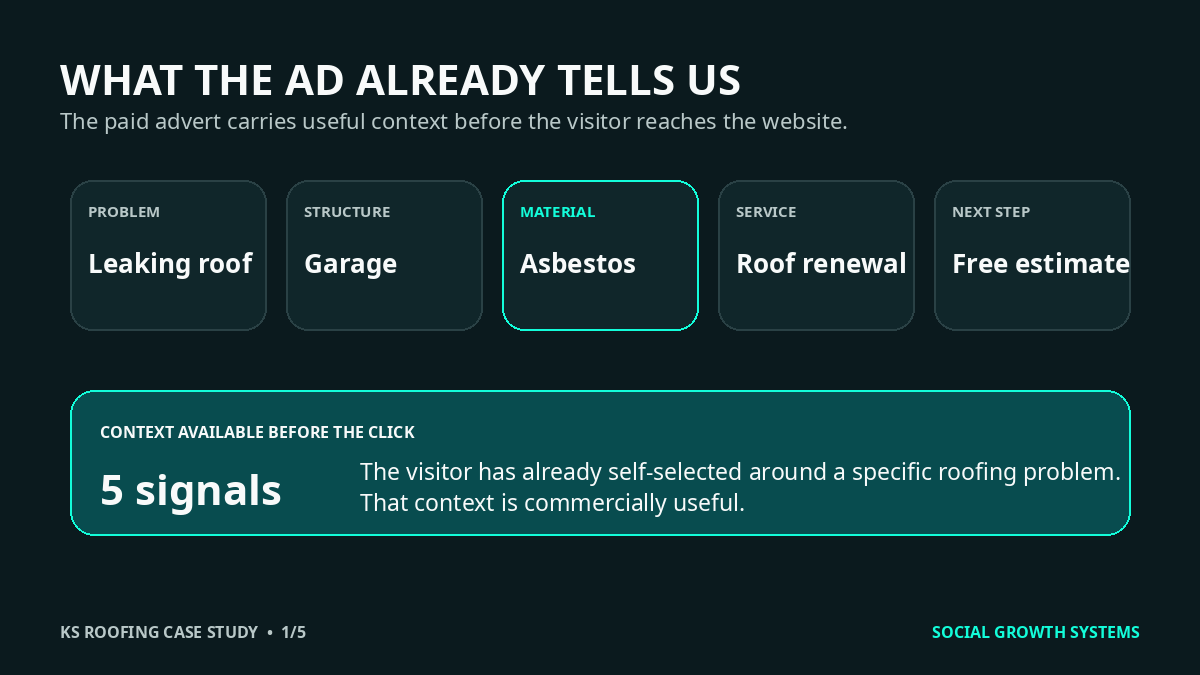
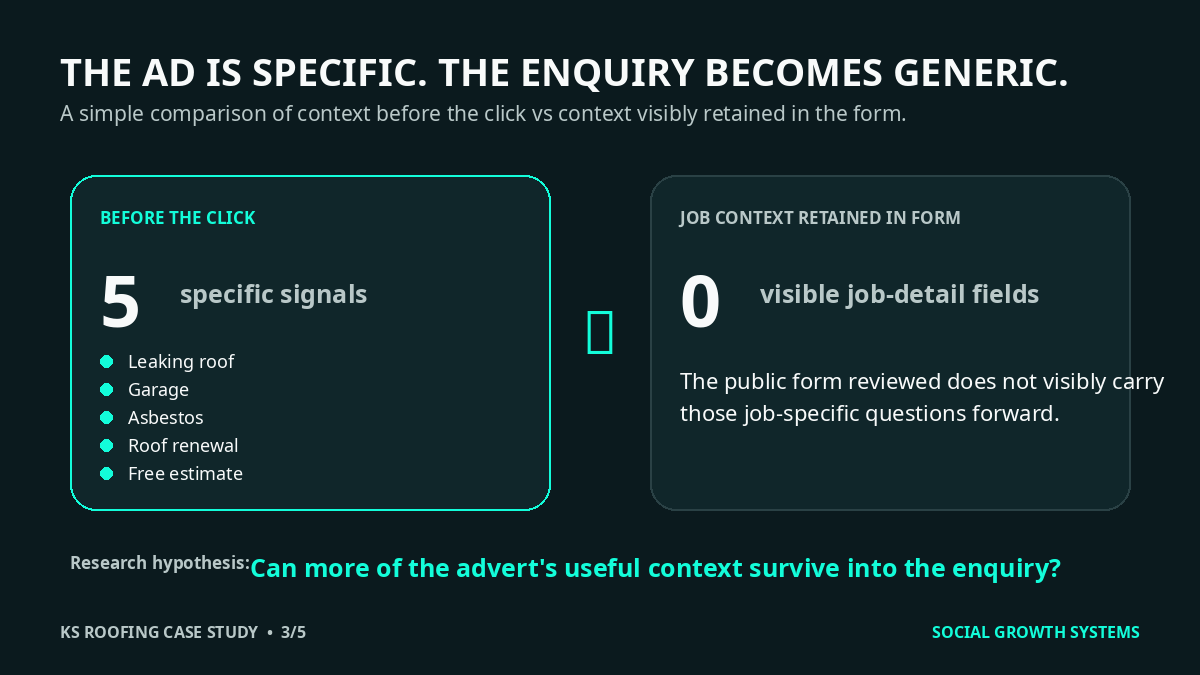
This was not a generic “we do roofing” advert. It referred to a leaking garage roof, asbestos roof renewal and a free estimate.
Before the customer reached the website, the advert already carried useful context about the problem they were interested in.
The enquiry route is where I found something worth testing
The public enquiry form I reviewed contained six visible fields.
First name, surname, email and telephone.
City and postcode.
No visible questions about the roofing job itself.
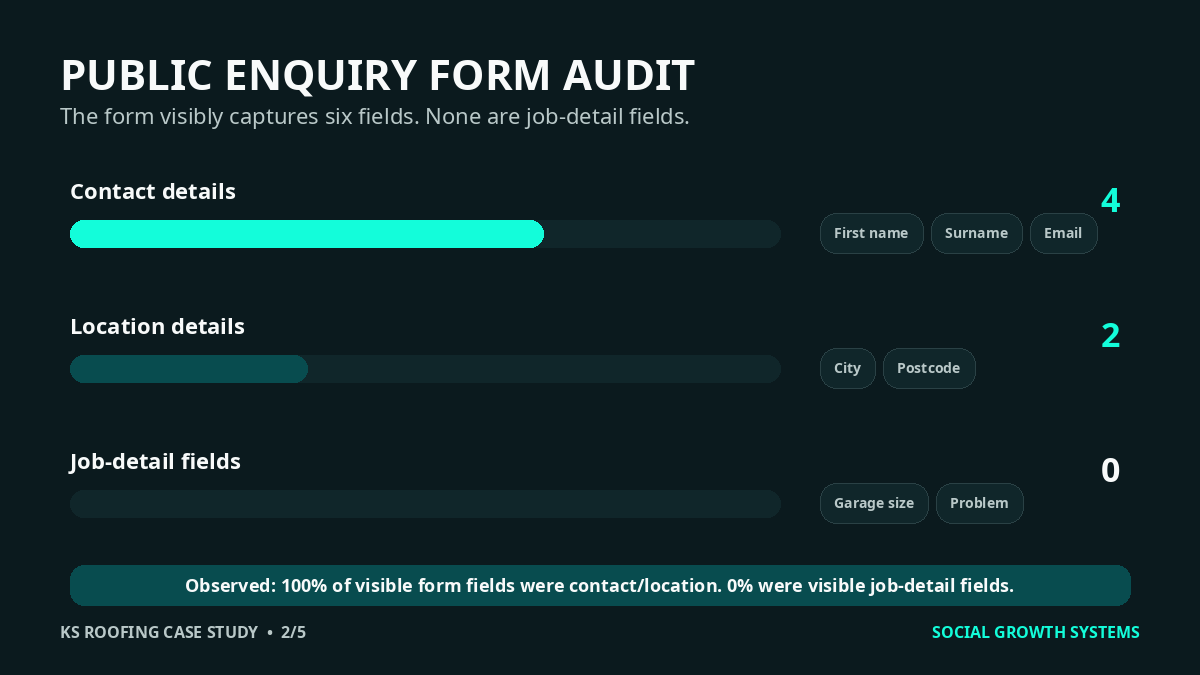
I could not see a question about whether it was a single or double garage, whether the roof was leaking, damaged or planned work, whether asbestos was confirmed or suspected, an optional photo upload or an approximate timescale.
None of that makes the existing form “bad”. A short form may be deliberate. But it gives me a sensible hypothesis to test.
A contact and a useful enquiry are not always the same thing
Imagine two messages arriving while you are on site.
Enquiry one
John Smith. Telephone number. Chelmsford.
Enquiry two
John Smith. Double garage. Suspected asbestos roof. Currently leaking. Chelmsford. Wants replacement within the next month. Two photos attached.
Both are enquiries.
The second gives the roofer far more useful information before picking up the phone.
This business already has plenty of proof
That is what makes this case more useful than a simple “bad website” teardown.
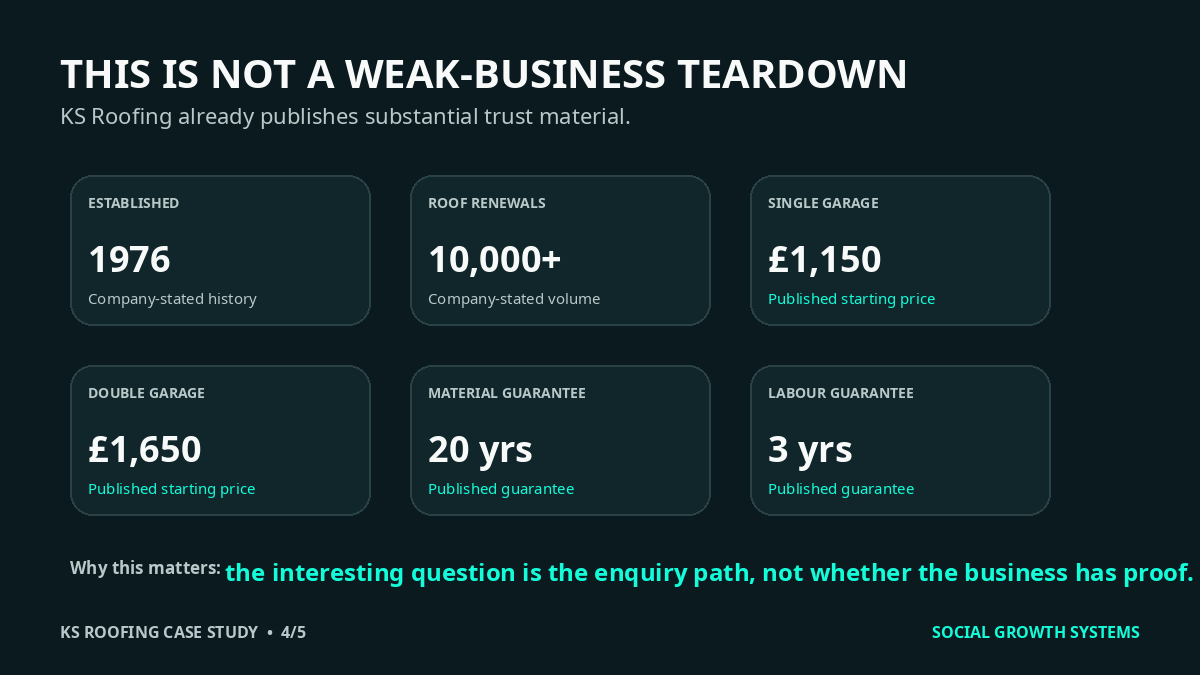
The business publishes substantial trust material already.
Its website states that it has operated since 1976 and completed more than 10,000 roof renewals.
It also publishes starting prices and guarantee information.
Those are the business’s own published claims. I am not presenting them as independently verified results.
But they show that the raw material for trust is already there.
What I would test next
I would not rebuild the entire website.
I would not turn the enquiry form into a twenty-question application either. Nobody needs planning permission just to ask about a garage roof.
I would test whether a little more useful context can be carried into the enquiry without making the customer work harder.
A small test, not a full rebuild
Keep the questions directly connected to the job the advert was promoting.
Single or double garage. Leak, damage or planned replacement.
Postcode, asbestos known or suspected, optional photo and timescale.
Name, phone and email after the useful project context is captured.
Then I would measure what actually happens.
Does the revised route produce enquiries that are easier to understand?
Does it create too much friction?
Do suitable enquiries become quotes?
Do those quotes become work?
What did the click and enquiry actually cost?
This is where the public analysis reaches its limit.
I do not have this business’s total ad spend.
I do not have its click volume.
I do not have its enquiry volume.
So I cannot honestly calculate either cost per click or cost per enquiry.
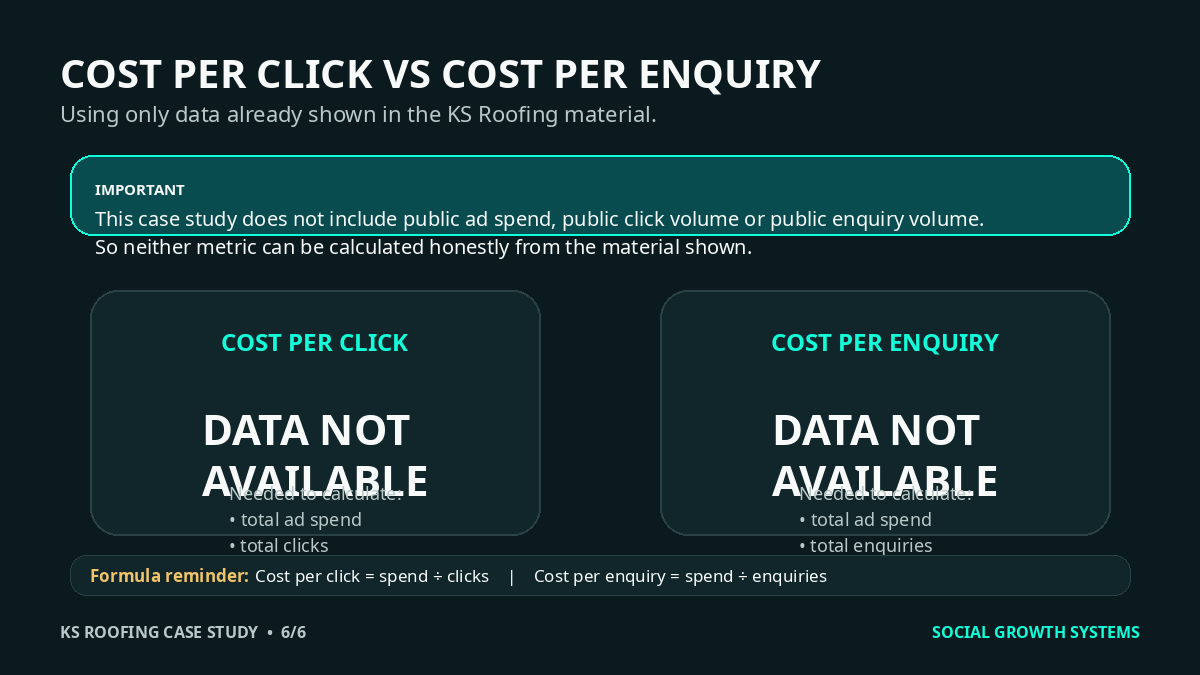
And that is not a gap I would fill with a guess.
If I had access to the real account and enquiry records, I would want to connect the journey further than the click:
Paid click
Enquiry
Qualified enquiry
Quote
Job won
Then the useful question changes.
What this case study proves, and what it doesn’t
A dramatic teardown would be easier to write.
“They’re wasting their ad budget.”
“This form is losing them customers.”
“Here’s the conversion fix.”
I do not have the evidence to make any of those claims.
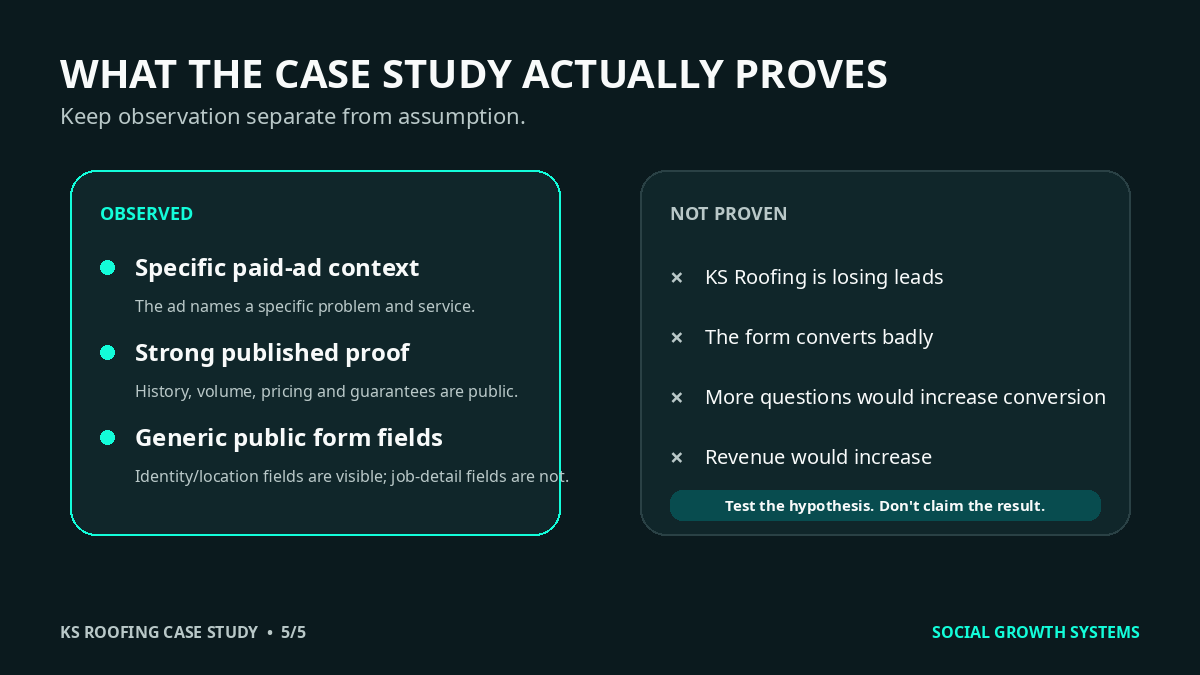
What I observed
- A specific paid-ad message.
- Strong public trust material.
- A form focused on contact and location details.
- No visible job-detail fields in the form reviewed.
What I cannot prove
- That the business is losing leads.
- That the form converts badly.
- That my proposed test would increase conversion.
- That changing the form would increase revenue.
Don’t automatically blame the advert
When paid marketing does not appear to be producing enough useful business, Ads Manager is the obvious place to look.
Change the creative.
Change the audience.
Change the campaign.
Increase the budget.
Sometimes that is exactly where the problem is.
Sometimes the advert has already done its part.
The snag appears after the click.
Established trade businesses already have real things worth trusting: completed work, experience, reviews, specialist knowledge and a reputation built job by job.
The online journey has to make enough of that visible, then make the next step clear.
Want me to check yours?
I will find the five things I would fix first.
The £149 Sprint is a one-off review for UK trade and construction businesses whose online presence, visible trust or enquiry route needs fixing before more time or money goes into marketing.