
The Phone’s Gone Quiet. Do You Cut Your Price or Fix Where the Work Is Coming From?
You have not suddenly become worse at building. But the diary is thinner, quotes are taking longer and customers are thinking harder before spending. Before giving away margin, work out whether the real snag is price, demand, your source mix or what prospects find when they check the business.

UK construction output in the three months to July 2026. ONS source ↗
CITB expects activity to remain subdued in 2026 before recovering from 2027. CITB outlook ↗
Good opportunities to review before deciding that your price is the problem. This one comes from your own records, not a marketing dashboard.
Do not cut price first. Separate a genuine market slowdown from a problem in your own pipeline. Review where your best jobs came from, which sources bring poor-fit price shoppers, and what a referred prospect sees when they verify the business online.
The diary is getting thinner
You have not suddenly become worse at building.
But the phone is quieter, quotes are taking longer and customers are thinking harder before spending.
So the obvious question becomes: do you lower your prices to get the diary moving again?
Sometimes price genuinely is part of the problem. But before cutting margin, I would ask a different question:
Where did your good building work come from when the diary was healthy, and what has changed?
There is real pressure in the UK construction market. The Office for National Statistics estimated that total construction output fell by 0.5% in the three months to July 2026, with both new work and repair and maintenance declining over that period. ONS
The September UK Construction PMI also remained below the 50 level that separates growth from contraction. Reuters reported subdued new orders, longer sales cycles and clients delaying decisions on larger projects. Reuters
So if work feels harder to win, you are not necessarily imagining it.
But that still does not tell you what is happening inside your business.
The diary has softened, but the underlying source of good work is still functioning.
Too few suitable opportunities are reaching the business and the forward book is getting weaker.
You are still getting enquiries, but too many are poor fit, price-led or unlikely to become worthwhile work.
Referrals know your reputation. Newer prospects still have to decide whether what they find online supports it.
CITB's Construction Workforce Outlook is useful context here. It expects construction activity to remain subdued during 2026 before recovering from 2027, with performance varying by sector and region. CITB
A slower market and a broken pipeline are not automatically the same thing. Cutting your price will not tell you which one you have.
Buying work can make a full diary look healthier than the business really is
When gaps appear in the diary, it is easy to become less selective.
- You quote jobs you would normally leave alone.
- You travel further for weaker-fit work.
- You accept awkward projects because something feels better than nothing.
- You spend hours pricing people who were never a realistic fit.
- Eventually someone says, “We are losing jobs. We need to be cheaper.”
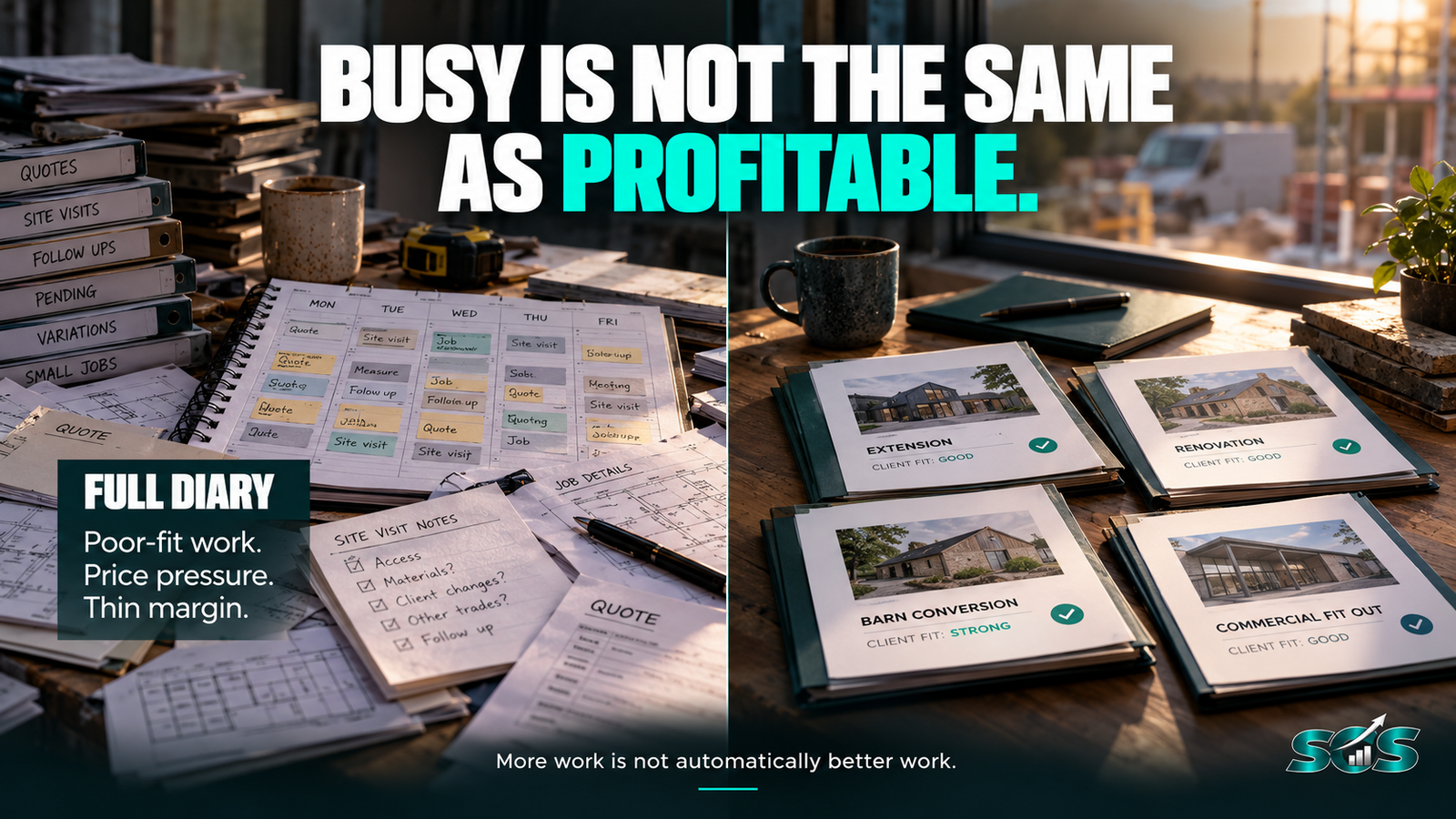
That can become a bad loop. Price comes down. Margin gets squeezed. The business needs more jobs to make the same money. More jobs create more delivery pressure.
Being busy and making money are not the same thing.
That tension appears in real owner discussions. In a February 2026 UK small-business thread, an experienced construction business owner described competitors trying to “buy work” and the situation as a “race to the bottom”, while making the point that he did not want to become a “busy fool”. Owner discussion
That thread is anecdotal, not representative market research. But it captures the decision owners are actually facing: protect margin, or chase volume by price.
TrustMark's homeowner guidance also explicitly tells consumers not to choose solely on price. It recommends comparing quotations alongside recommendations, websites, customer feedback and previous work. TrustMark
Ask where your good jobs used to come from
Do not start with: Which marketing channel should I use?
Start with: Which source produces the kind of job I actually want?
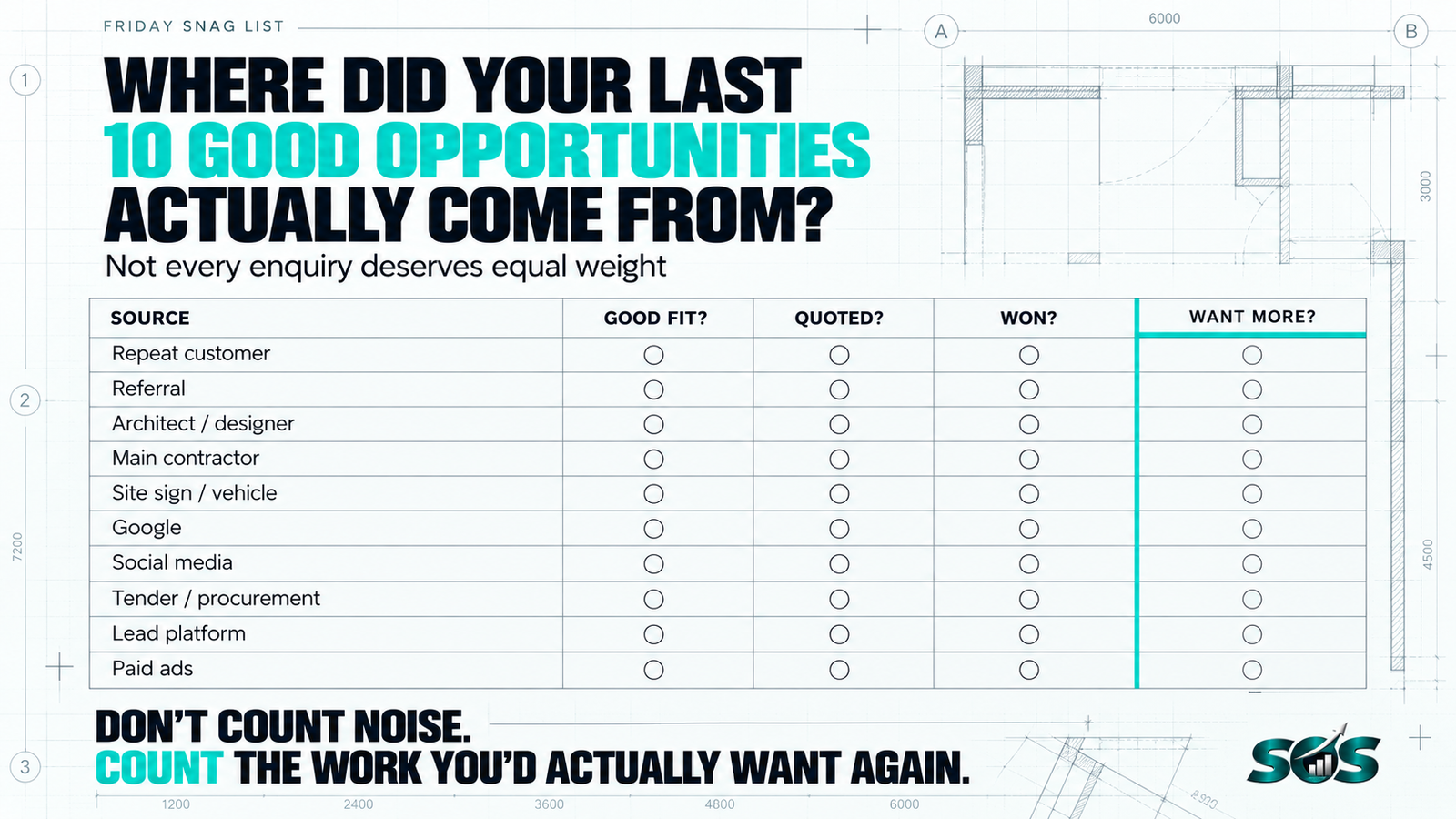
Look back at your last ten genuinely worthwhile opportunities. Not every Facebook message. Not every “How much for an extension mate?” message. Look at the opportunities that had credible commercial potential.
Check the source:
- repeat customers;
- referrals;
- architects or designers;
- main contractors;
- housing associations or other established relationships;
- site boards and signwritten vehicles;
- Google;
- Facebook, Instagram or LinkedIn;
- tender or procurement lists;
- paid lead platforms;
- paid advertising.
Then ask four questions
- Was it the right type of project?
- Was the customer serious?
- Did you win it?
- Would you genuinely want more work like it?
That last question gets missed surprisingly often. A source can generate plenty of enquiries and still be a poor source of business.
The Federation of Master Builders makes a similar point in its guidance on qualifying job leads. More enquiries are not automatically the answer if a builder is spending time on site visits and quotes that are unlikely to progress or do not suit the business. FMB
The useful question is not, “Where can I get more leads?”
It is, “Where do the right opportunities come from, and what can I realistically strengthen?”
Word of mouth can be excellent. The risk is when it is the only system
If years of good work have created enough referrals to keep your diary healthy, I would not tell you to replace them with some shiny marketing system.
That would be daft.
The problem starts when word of mouth is not simply your best source of work. It is your only dependable source.
You cannot turn referrals up by 20% next Tuesday because the diary looks thin.
You can ask for introductions, maintain relationships, follow up previous customers and make the business easier to recommend. But you do not control when somebody's neighbour suddenly needs a builder.
A South East builder described a similar problem in another UK small-business discussion: work booked for a few months, uncertainty after that, and a search for better sources through Google, local advertising, site signs, planning applications and other routes. The owner also described poor-fit leads from a paid trade platform. Owner discussion
Again, that is anecdotal. It is useful because it shows the real decision: not “does marketing work?”, but which route is producing the type of work this business actually wants?
Don't be everywhere. Be easy to verify everywhere that matters
This is where marketing advice often becomes ridiculous.
Suddenly the builder is supposed to become a videographer, copywriter, SEO specialist and part-time TikTok presenter after getting home from site.
No.
You do not need to be everywhere. You do need to think about what happens after somebody hears your name.
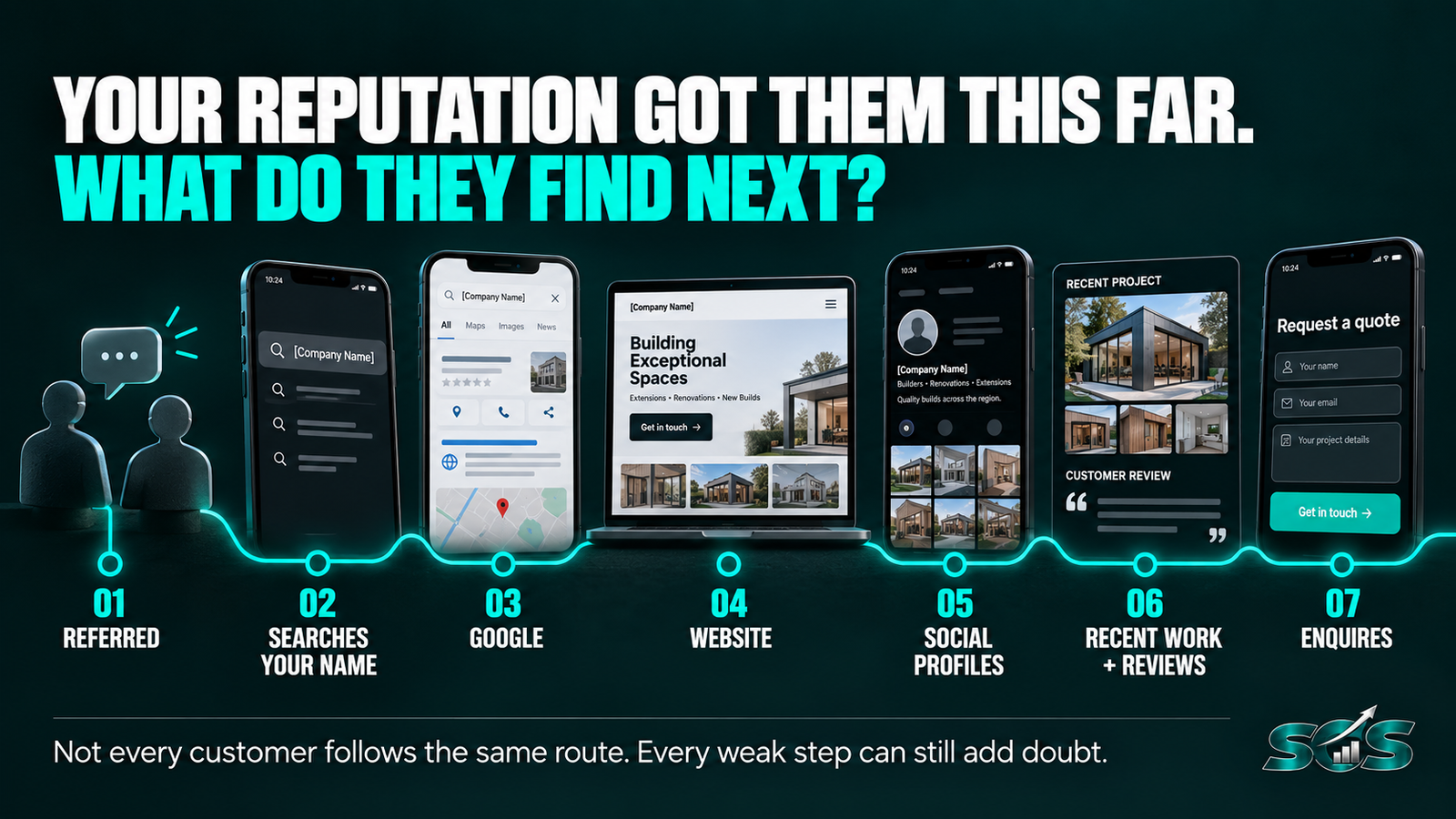
A common journey might look something like this:
Referral → business-name search → Google → website → social profiles → recent work and reviews → enquiry.
Not every customer will follow that exact route. The point is that each touchpoint can reinforce the recommendation or introduce doubt.
TrustMark tells homeowners to research a tradesperson's website, references, customer feedback and previous work before committing. TrustMark
There is also evidence that digital checks matter particularly for younger homeowners. Research published by the Federation of Master Builders and HomeOwners Alliance in August 2026 found that homeowners under 35 were more likely than older homeowners to use online reviews and were more likely than the overall average to judge a builder using website and branding signals. FMB also warned that online signals should not replace proper vetting. FMB research
Your website and social profiles do not create the reputation. Your work does. Their job is to stop hiding it.
A customer who has already been told you are good should not have to dig through a forgotten Facebook Page, an empty Instagram account and a website with no recent projects to work out whether the recommendation is still worth pursuing.
The work is already happening. I can take the ongoing social media job off your plate.
I use the real projects, reviews, facts and source material your business already has to keep the online presence current, credible and useful when prospects check you. Monthly management is not a promise that social media will fill the diary. It is ongoing implementation so the business does not disappear online whenever you get busy on site.
One core platform kept current and credible.
Facebook and Instagram managed as one joined-up presence.
Management plus agreed community support and monthly adjustment.
Higher-intensity management for businesses with the activity and capacity to justify it.
I recommend the smallest sensible scope for the actual job. A higher package is not automatically a better fit.
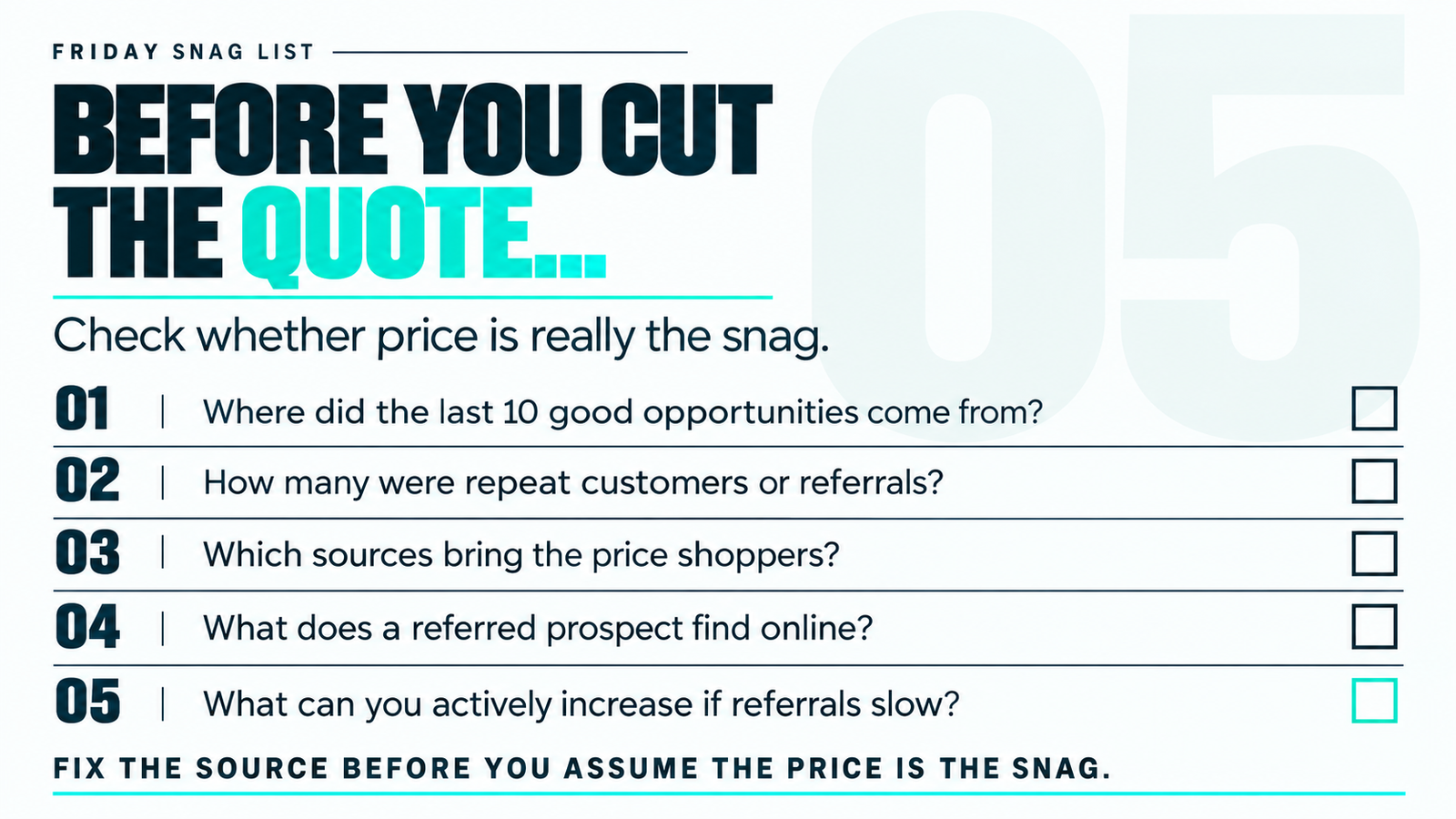
Before you cut the quote, check whether price is really the snag
You should be able to answer these from your own enquiry and job history.
The useful argument is not whether “marketing works”
The useful argument is what is happening in real construction businesses right now, and which sources are producing work worth taking.
Those answers will differ between a roofing contractor, an extension specialist, a commercial fit-out business and a property-maintenance firm.
The important thing is knowing yours.
Sources used in this Friday Snag List
Official and industry sources support the market and buyer-behaviour points. Reddit discussions are included only as owner-level anecdotal evidence and are labelled accordingly.
If the only way to keep the diary full is to become the cheapest quote, the real snag isn't your price.
Find out where the right work is coming from. Then make sure the reputation you have built offline is doing its job when somebody checks you online.