
30 Enquiries a Month. One Job. Is That Really a Lead Generation Problem?

Your marketing report says you've had 30 enquiries this month.
Sounds promising. Until you find out that only one turned into a job.
It's tempting to look at those numbers and decide you need more leads. But before spending another penny, I'd want to know a bit more about the other 29.
Were they asking about the type of building work you actually want? Were they in your area? Did they have a realistic budget and a timescale you could accommodate?
And how many got as far as a proper conversation, site visit or quote?
Because 30 enquiries and one job doesn't necessarily mean your marketing isn't working.
You could be attracting the wrong customers. Your business might not be showing people clearly enough what you specialise in. Perhaps you're losing suitable opportunities somewhere between the first phone call and the final quote.
Or you might simply be paying for enquiries that were never a good fit in the first place.
Before trying to generate more enquiries, find out what's happening to the ones you're already getting.
More enquiries don't necessarily mean more good opportunities
An enquiry is simply someone getting in touch. It doesn't tell you whether there's a worthwhile job behind it.
Take two enquiries arriving at a building company on the same morning.
One person wants a rough price for some building work. They haven't decided exactly what they want, when they'd like it done or what they can afford.
The other has plans for a substantial extension, lives within your service area and wants to speak to a contractor about starting in a few months.
Both count as one enquiry.
But they're very different prospects for a company specialising in extensions.
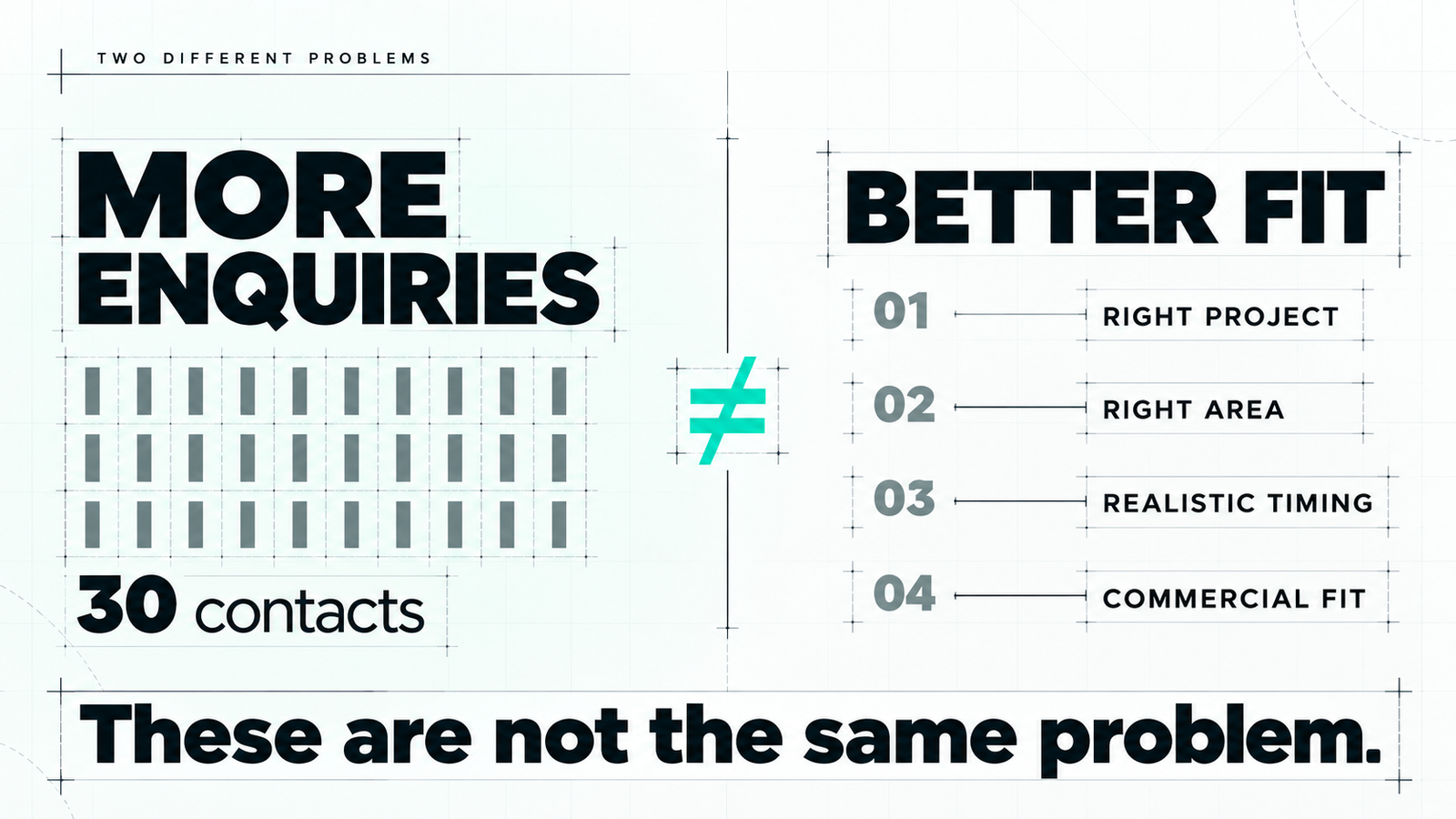
That's what gets lost when marketing performance is judged purely by the number of people who make contact.
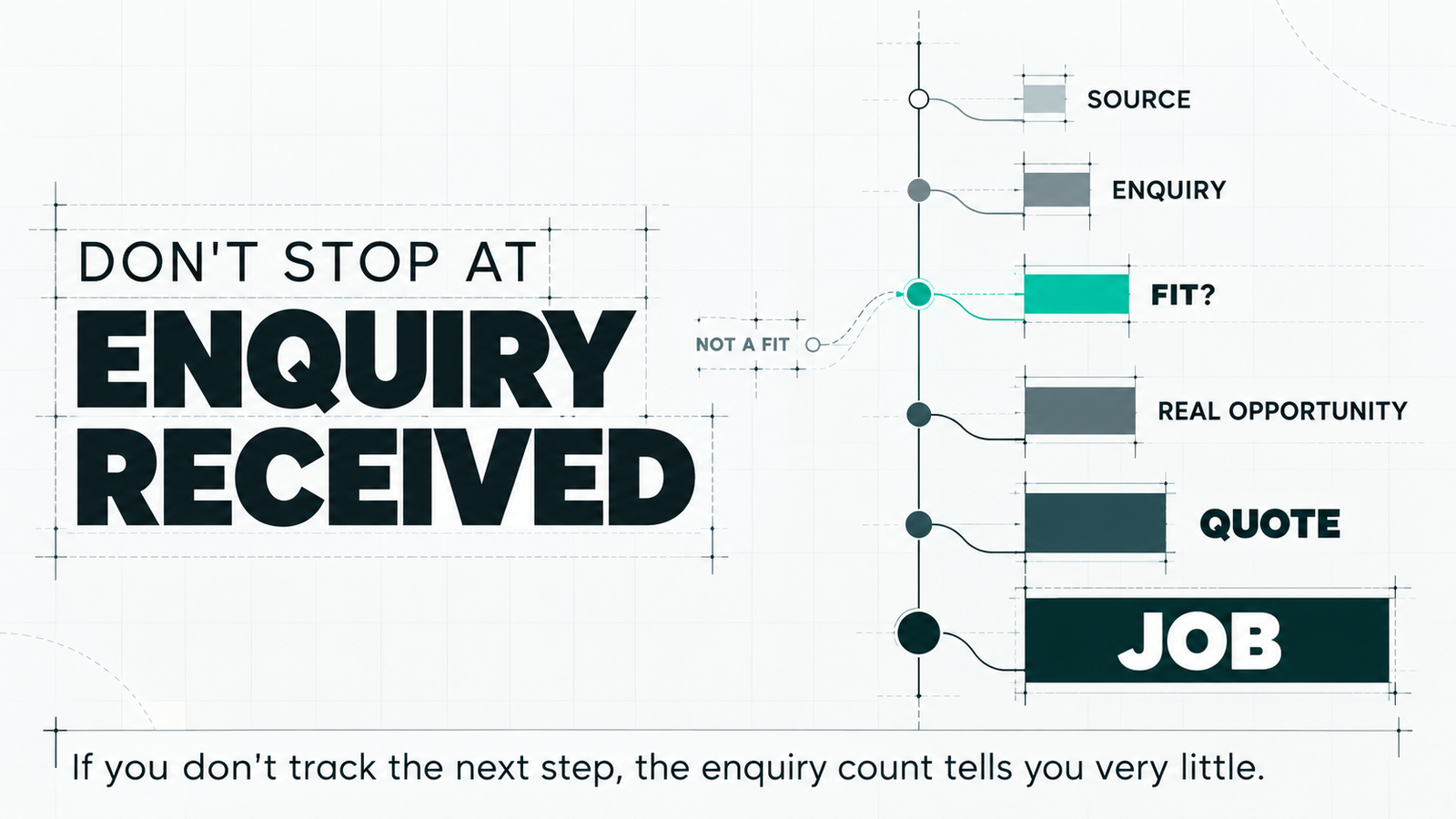
I'd want to see how many enquiries were suitable, how many led to useful conversations, which ones were worth surveying and quoting, and what happened afterwards.
If nobody's recording that information, it's difficult to tell whether you need more enquiries or simply better ones.
And putting more money into marketing before you know the difference could mean paying to deal with more of the same problems.
But one job from 30 enquiries isn't automatically a disaster
There's another point worth making.
A construction company could win one job from 30 enquiries and still have a commercially worthwhile source of work.
Suppose that one job is a profitable renovation project. If the marketing cost was reasonable and the other enquiries took very little time to deal with, the numbers might make perfect sense.
Now imagine the opposite.
You win a relatively small job, having paid for all 30 enquiries and spent hours visiting properties, measuring up and preparing quotes that went nowhere.
Same number of enquiries. Same number of jobs won.
Completely different commercial result.
It's why I wouldn't make a decision based on an enquiry-to-job percentage alone.
I'd also want to know what it cost to generate those enquiries and, just as importantly, how much time went into dealing with them.
The hours spent on a quote belong in the calculation too
Let's say someone contacts your business about a possible building project.
You read the enquiry and reply. There's a phone call to discuss the job, followed by a site visit. You take measurements, ask a few more questions and spend an evening putting together a quote.
You send it over.
A few days later, you follow up.
Nothing.
Anyone who's run a building business will recognise that situation.
The enquiry itself might have cost £20, £40 or nothing at all. But you've still spent time on it, and that time has a cost.
Here's an illustrative breakdown of what one unsuccessful enquiry might involve:
| Activity | Time spent |
|---|---|
| Reading and responding to the enquiry | 10 minutes |
| Initial phone call | 20 minutes |
| Travel, site visit and measuring | 90 minutes |
| Preparing the quote | 45 minutes |
| Following up | 15 minutes |
| Total | 3 hours |
These are example figures, not an industry average or a claim about a real business.
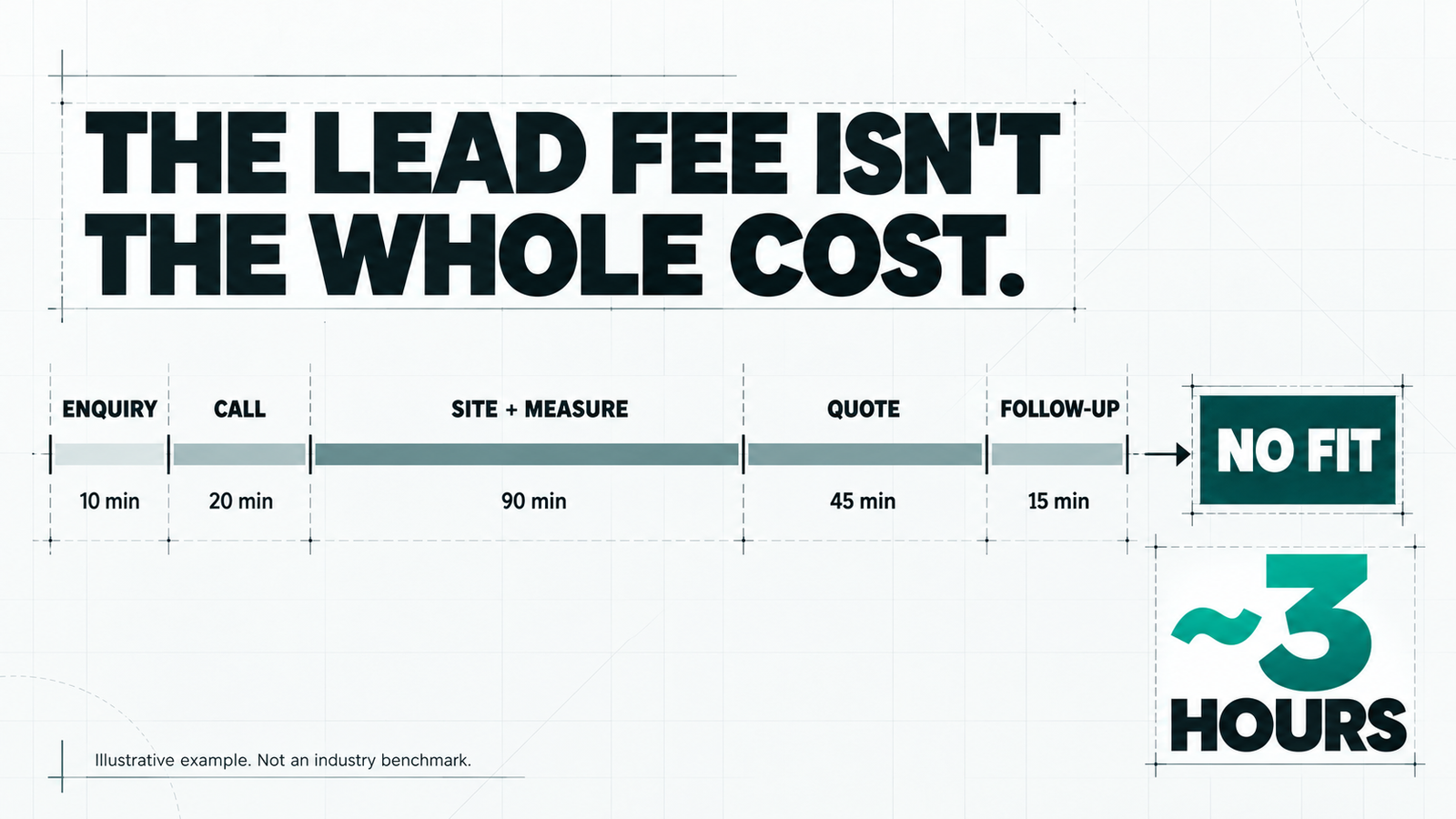
Three hours might not sound excessive for a genuine opportunity.
But what if several enquiries every month take that much time, despite having little realistic chance of becoming jobs?
The cost starts adding up.
And unlike the fee you pay for an enquiry, the time spent dealing with it doesn't always appear in your marketing reports.
That's something I'd want to understand before recommending another advertising campaign or lead source.
What about paid lead platforms?
Platforms such as MyBuilder, Bark and Checkatrade can be useful sources of work. They can also become expensive if the enquiries aren't right for your business.
The important thing is understanding how each one works and what you're actually paying for.
According to MyBuilder's published terms, a tradesperson can be charged a Shortlist Fee when the customer's contact details are shared. That fee doesn't depend on whether they eventually win the job. [SOURCE 1]
Bark describes its model as charging professionals for introductions that provide potential customer contact details. [SOURCE 2]
Checkatrade has different lead arrangements, including an Opportunities Board where members can use credits to access customer contact information. [SOURCE 3]
These aren't identical systems, so it wouldn't be fair to treat them as though they all operate in the same way.
Tradespeople's experiences vary too.
In a discussion among UK electricians, several contributors were unhappy with Checkatrade or MyBuilder. Another said MyBuilder had been useful for around six months after returning to the UK, while they were rebuilding their customer contacts. [SOURCE 4]
A separate discussion among UK small-business owners showed a similar split. Some complained about the cost and competition involved in pay-per-lead services, while others had found them worthwhile. [SOURCE 5]
Those comments are individual experiences, not evidence of how well the platforms perform for everyone.
My point isn't that builders should avoid lead platforms.
It's that you need to know what each source is costing you and whether it's bringing in the sort of work your business wants.
If you're competing with several other contractors for the same customer, the decision may come down to a mixture of price, availability, confidence and how clearly you've shown what your business can do.
For a substantial construction project, I'd be cautious about building a marketing strategy that relies mainly on being the cheapest quote.
Work out whether you have a volume problem or a quality problem
If a building company tells me enquiries are disappointing, I wouldn't immediately suggest more advertising.
First, I'd want to understand which of these situations they're dealing with.
Not enough suitable people are finding the business
Perhaps the company does excellent extension and renovation work, but very few people outside its existing referral network know about it.
That may genuinely be a visibility problem.
Improving the website, showing more relevant projects, strengthening local search visibility, developing referral relationships or running carefully targeted advertising could all be worth considering.
The right choice depends on the business and where its customers currently come from.
Plenty of people are enquiring, but too few are suitable
This needs a different approach.
If a contractor mainly wants substantial renovation work but keeps receiving requests for small repairs, I'd want to look at how the business describes and presents its services.
If enquiries regularly come from outside the service area, that tells us something else.
And if people are consistently approaching the company with unrealistic budget expectations, it's worth investigating where those expectations are coming from.
I'd look for patterns in the project type, location, scale, timing, customer expectations and enquiry source.
You might discover that one particular channel brings in plenty of activity but very few suitable opportunities.
That's far more useful information than simply knowing how many enquiries came in last month.
Make it easier for the right customers to recognise your business
Here's something I see as particularly relevant to established building companies.
A business can have years of experience in extensions, renovations or commercial refurbishment, yet describe itself online as offering:
"All aspects of building work undertaken."
That might be technically correct.
But it doesn't tell a potential customer much about the projects you're particularly good at or the kind of work your company is set up to handle.
Say your business specialises in larger residential extensions across Essex.
I'd want a potential customer to recognise that when they visit your website, look through your Facebook page or check your recent work.
Show them the extensions you've completed. Explain what was involved, where the project took place and what your team delivered.
If you've solved a difficult access problem or worked around an awkward existing layout, that's useful context.
It helps someone considering a similar project see that you have relevant experience.
Compare that with a finished-project photo captioned:
"Another one completed. Get in touch for a free quote."
The photo might be excellent, but the customer is left guessing what the job involved.
You don't need to turn every project into a lengthy case study. A few accurate details can make it much more useful.
And you're not trying to discourage every customer who needs something different. You're helping people understand what your business does well, so they can make a more informed decision before contacting you.
Getting found is only part of the decision
There's another reason I think project proof matters.
People don't necessarily stop researching a contractor once they've found the business.
Someone might hear your name from a neighbour, see you recommended in a Facebook group or discover your business through a lead platform.
Then they look you up.
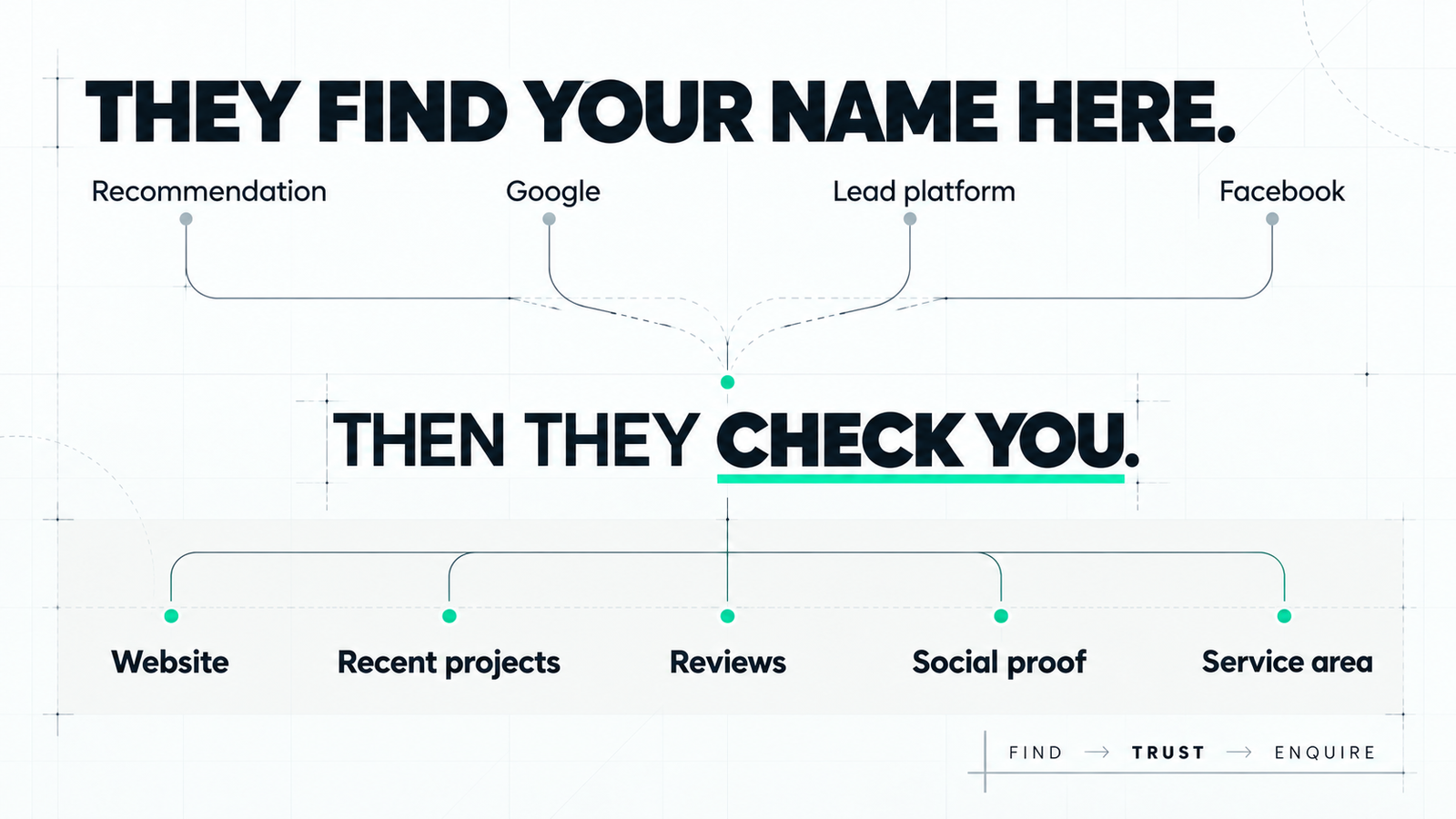
The Federation of Master Builders advises homeowners to check things such as relevant experience, previous work, reviews, references, insurance and communication when choosing a builder. [SOURCE 6]
In one UK discussion about lead platforms, a contributor described discovering tradespeople through sites such as Checkatrade, then checking their website, social media and Google reviews before making a decision. [SOURCE 5]
That's one person's account, not proof that every customer behaves this way. But it's a useful reminder that getting noticed and earning someone's confidence are separate parts of the process.
Imagine two building companies that both come recommended.
One has recent projects showing the type of work the customer wants, clear service information and genuine reviews.
The other has an old Facebook page, a handful of unexplained photos and very little information about its recent work.
That doesn't prove the first company is better at building.
But it does give the customer more information to help them decide.
This is where some established construction businesses are missing an opportunity.
They've already done the work. They've built the reputation. Their customers may be perfectly happy.
Yet very little of that is visible to someone who doesn't know them.
And if potential customers can't see the experience behind the business, they're left to make their decision using whatever information is available.
Sometimes that means comparing quotes without properly understanding the differences between the contractors.
Where social media management comes into it
I don't think social media is the answer to every lead generation problem.
Posting more often won't necessarily attract better customers, and a polished Instagram account won't fix an unclear quote or poor follow-up.
But social media can help a building company show people what it actually does.
That's the part I focus on with Social Growth Systems.
For an established contractor, there may already be plenty of useful material available: finished projects, site progress photos, customer feedback, details of specialist work and questions that customers regularly ask.
The challenge is getting that material out of people's phones and into a useful, consistent online presence.
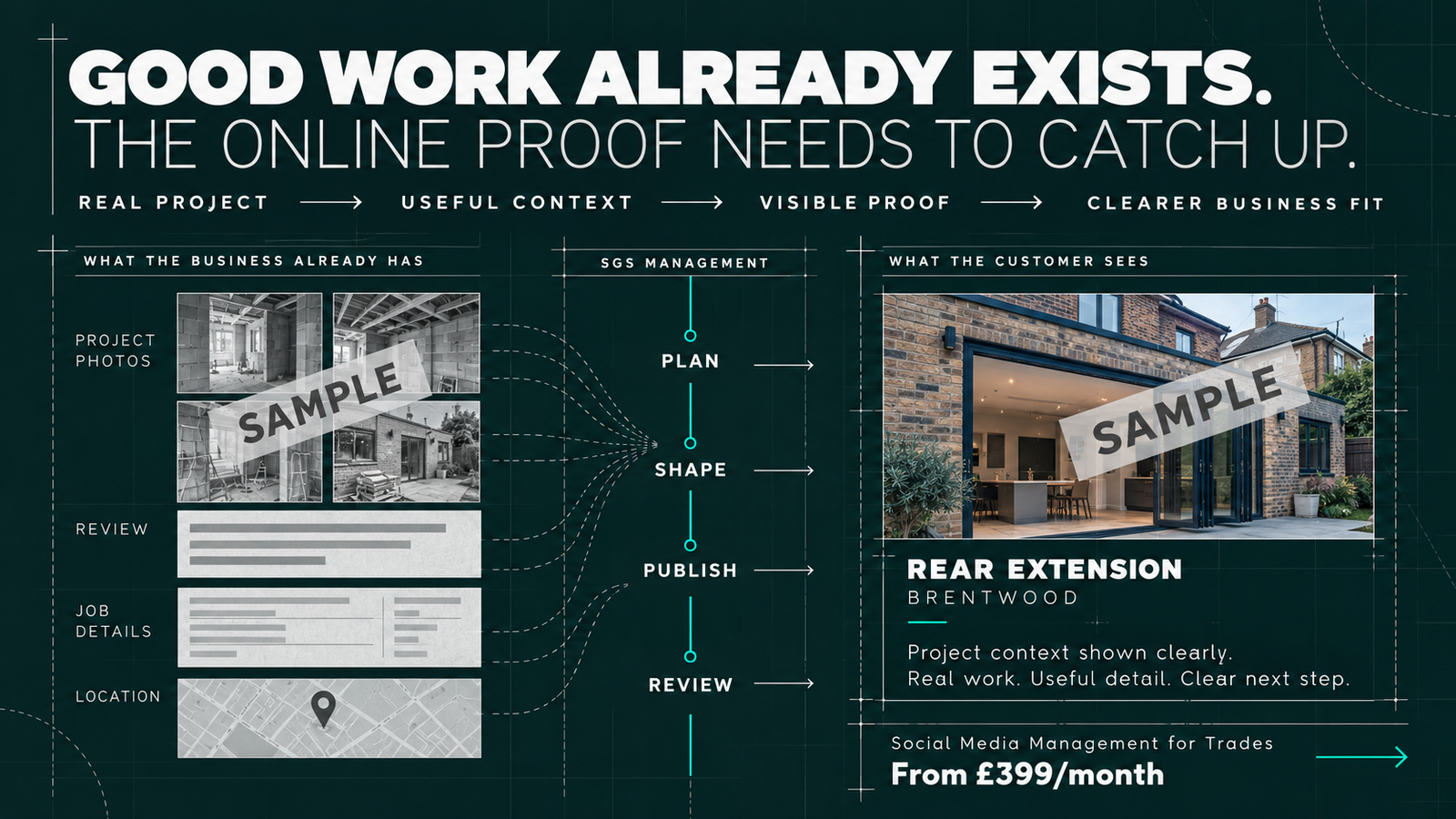
If your company specialises in extensions, your content should make that clear.
If you're known for high-quality renovation work, people should be able to see examples.
If a potential customer wants to know how your business approaches a project, there's an opportunity to explain it.
I'd rather see a smaller number of useful posts showing real work than a busy feed full of generic advice that could belong to any construction company.
The aim is to help the online impression match the quality and experience of the real business.
I also think it's important to look beyond likes and follower numbers. They're useful supporting information, but they don't tell you whether the business is attracting suitable enquiries or winning jobs.
That requires looking at what happens after someone shows an interest.
If you're running an established trade business and would rather have the ongoing social media work handled for you, my management services start from £399 per month.
I look at what your business actually needs before recommending a management package.
What I'd track before spending more on leads
You don't need an expensive system to start understanding whether your enquiries are worthwhile.
Even a simple spreadsheet can give you a much clearer picture, provided you record the information consistently.
Here's what I'd include:
| What to record | What it helps you understand |
|---|---|
| Enquiry source | Where the customer found you |
| Project type | Whether it's the work your business wants |
| Location | Whether the job falls within your service area |
| Timing | Whether the project fits your availability |
| Qualified or not | Whether it's a realistic opportunity |
| Reason not qualified | Why an enquiry wasn't suitable |
| Quote sent | Which enquiries progressed to pricing |
| Job won or lost | What happened after the quote |
| Reason lost, if known | Whether there's a recurring issue |
Over time, you can start comparing sources properly.
Perhaps Facebook brings fewer enquiries than a paid lead platform, but more of them fit the projects you want.
Maybe referrals take longer to arrive but are more likely to progress to a site visit.
Or perhaps you're spending a surprising amount of time preparing quotes for one particular type of enquiry that rarely goes anywhere.
Those are possibilities to investigate, not assumptions to make in advance.
The point is to stop treating every enquiry as though it has the same value.
"Facebook brought us 22 enquiries" is useful information.
But it doesn't tell you whether those enquiries were relevant, whether anyone followed them up or whether any became paid work.
To understand that, you need to follow what happened next.
Three questions for this Friday
If you're paying for leads, spending money on advertising or wondering why enquiries aren't turning into enough work, these are the three questions I'd start with:
- How many of last month's enquiries were actually suitable for the type of jobs you want?
- Which source brings in the most unsuitable enquiries, and why?
- How much time did you spend visiting, measuring and quoting jobs that didn't go ahead?
You might find that you genuinely need more enquiries.
But you might also discover that improving the quality of enquiries, making your experience easier to see or tightening up what happens after first contact would be a better place to start.
Thirty enquiries can look impressive in a report. I'd be more interested in what happened to them.