
Social media for builders works best when it makes real work easier to find, understand and trust. It is not about becoming a content creator, posting every day or chasing followers.
A potential customer may hear your name through a recommendation, see one of your jobs locally, find you in Google or come across a post. Social media can then give them another place to check what you do, where you work and whether the business looks active and credible.
Use social media to show genuine projects, useful context, customer proof and the areas you work in. Make the next step clear when someone is ready to contact you. Do not expect posting alone to fix a weak offer, poor follow-up or a difficult enquiry route.
Why social media can matter for a building firm
Building work involves trust. A homeowner may be considering an extension, renovation or another substantial project before they ever speak to you. They are not only looking at the finished result. They are trying to decide whether the business itself looks credible enough to contact.
Word of mouth remains valuable, but a recommendation does not necessarily finish the decision. Someone can hear your name from a neighbour and then check your Facebook page, Instagram account, Google presence, reviews or website before making contact.
Research published in 2026 by the Federation of Master Builders and HomeOwners Alliance reported that 33% of homeowners under 35 relied on online reviews when hiring a builder, compared with 16% of over-55s. It also reported that 20% of younger homeowners judged a builder on website and branding, compared with 9% across respondents overall.
Important context
The published source is a summary of the research rather than the full dataset, and the organisations involved also promote builder-vetting services. I therefore treat the figures as useful context rather than proof that every homeowner behaves in the same way.
The useful job of social media: FIND → TRUST → ENQUIRE
I do not treat social media as a separate little marketing world. It sits inside the wider route a potential customer takes before deciding whether to contact a business.
FIND
Make it easier for someone checking your business to see current, useful information about the work you do and the areas you genuinely serve.
TRUST
Use real projects, progress, reviews, people and accurate business information to support the reputation you already have offline.
ENQUIRE
Give someone an obvious next step when they are ready, whether that is a call, message, form or visit to the relevant service page.
That is why the useful question is not simply, “How many times should I post?” It is, “What does a potential customer need to see next?”
Social media is only one part of your marketing.
If you want to see how social media fits with Google visibility, customer trust and the route to enquiry, the Marketing for Builders page explains the wider SGS approach.
Facebook or Instagram for builders?
There is no rule that every building business needs every platform. Start with the channels you can keep useful and current.
| Platform | Useful for | Good content to show |
|---|---|---|
| Local visibility, recommendations, business-page checks and community activity. | Recent jobs, reviews, project updates, service areas and clear contact information. | |
| Visual project proof and giving someone a quick view of the standard and type of work you do. | Before-and-after work, progress, finished projects, details, short clips and project stories. | |
| More relevant when commercial relationships, contractors, developers or professional connections matter to the business. | Projects, expertise, commercial work, business updates and professional proof. |
Facebook and Instagram are a sensible combination for many local building firms because one project can provide useful material for both. That does not mean you need to duplicate every post word for word or be active everywhere.
Two useful, current profiles are more valuable than five profiles you cannot maintain.
What should builders post on social media?
Start with the work already happening. A building site contains far more useful marketing material than the finished-job photo alone.
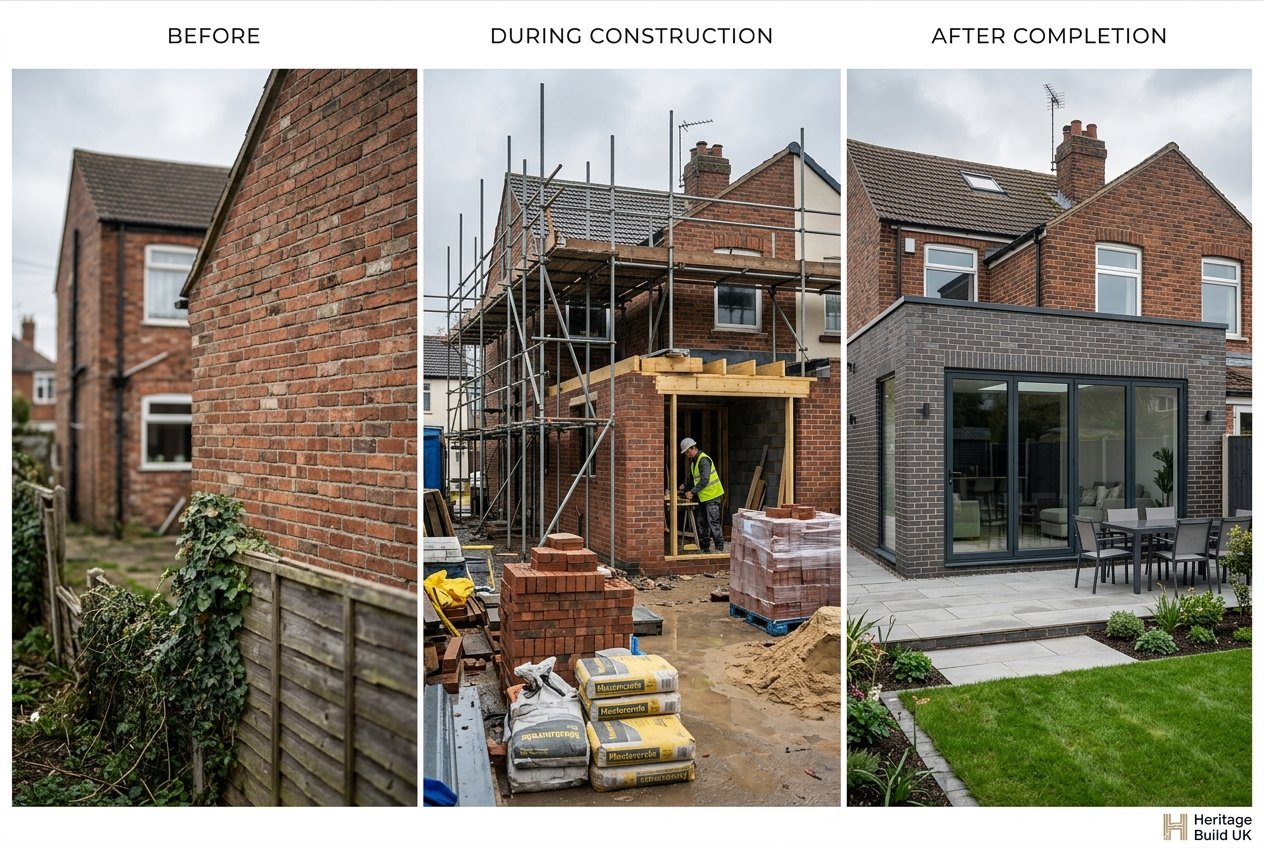
- Before the job starts. Show the genuine starting point. It gives the finished result context later.
- Progress that changes the shape of the job. Structural work, steels, first fix, roofing, plastering or another meaningful project stage can show that the work is real and current.
- A problem you had to solve. Explain what you found and what was done about it without revealing private customer information.
- Details that show the standard of the work. A finished edge, junction, preparation stage or tidy installation can be more useful than another generic “job done” post.
- The finished project. Show the result clearly, but also explain what work was carried out and what type of project it was.
- A genuine customer review. Use real feedback with permission. It should support the project proof rather than replace it.
- The real service area. Mention the town or area when it is accurate and appropriate to publish. That gives the work useful local context.
- Questions customers repeatedly ask. Useful answers can help a future customer understand the service before they contact you.
One project can create several useful posts
A loft conversion, extension or renovation does not need to become one finished-job post and disappear.
The same genuine project might give you a before photo, progress update, detail shot, problem-and-solution post, finished result, customer feedback and an answer to a question another homeowner is likely to have.
The objective is not to stretch one job into filler. It is to show different pieces of evidence that help a potential customer understand the work.
What can a builder post without finished-project photos?
If your old jobs were never photographed or the current project is nowhere near finished, you can still publish useful proof.
- Your team or the people customers will actually meet.
- Work in progress. It does not have to look finished to be useful.
- A common customer question answered clearly and within your actual expertise.
- Relevant qualifications, memberships or insurance where they are current and can be accurately described.
- Real customer feedback where you have permission to publish it.
- A service explanation. Tell people what type of job you take on and the areas you genuinely cover.
How often should a builder post on social media?
There is no proven magic posting frequency for UK building firms.
Use a cadence you can sustain with useful material. For some businesses that may mean one strong post a week. Others may have enough project material and capacity for two or three. More is not automatically better.
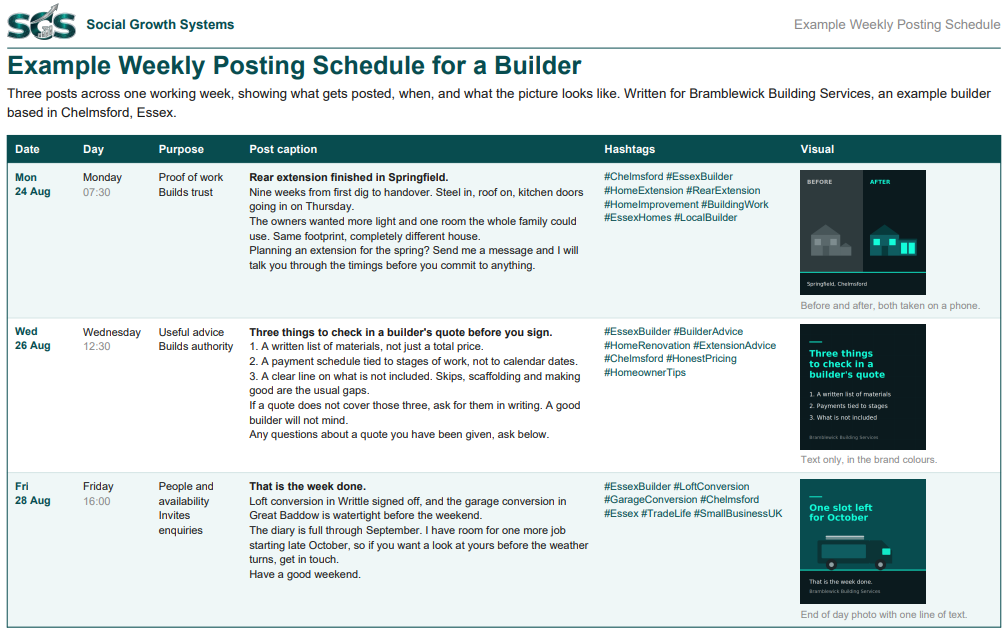
A useful rhythm is one you can keep going without lowering the quality of the proof. If you have a lot of strong material this month, use it. If the next month gives you less, do not invent filler just to reach a number.
Consistency matters because someone checking the business should be able to see that the information is current. That is different from saying that a particular number of posts will produce a particular number of enquiries.
Before you post a customer's house
Ask for permission first.
This is practical marketing guidance, not legal advice. Before publishing identifiable customer property, private information, reviews or people, make sure you have appropriate permission for what you intend to share.
Think about what is visible in the image as well as the project itself. House numbers, road signs, vehicle registrations, personal documents and security arrangements can reveal more than you intended.
If the customer does not want the property shown, respect the decision. You can still document other jobs or use content that does not identify them.
Social media and paid lead platforms do different jobs
Lead platforms and social media should not automatically be treated as substitutes for each other.
A lead platform may put a business in front of people actively looking for a trade. Social media is more useful as visible evidence someone can check before or after they hear about you elsewhere.
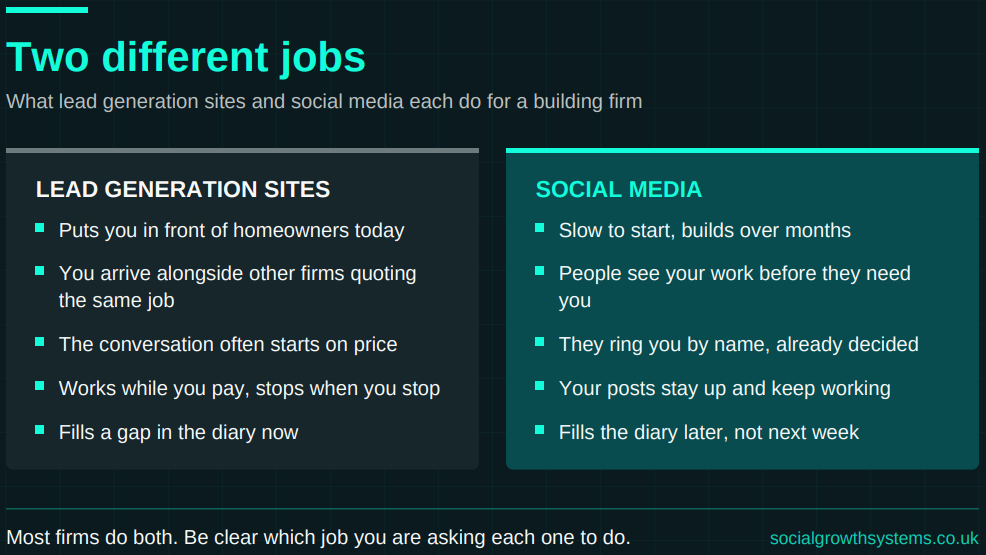
The right mix depends on the business, area, type of project, existing reputation, cost of each route and what your own enquiry data shows.
Do not assume the source with the most enquiries is automatically the best one. Track whether the enquiry fits the work you want, what service it relates to and what happens next.
Do builders need Facebook and Instagram Ads?
Not automatically.
Paid traffic makes more sense after the offer, visible proof, enquiry route, tracking and response process are ready for more attention. Sending additional people into a weak customer journey can simply expose the same problem to more people.
If you are considering paid reach, use the Facebook & Instagram Ads Readiness Checklist before deciding whether ads are the right next step.
What social media will not fix
Social media can support visibility and trust. It cannot compensate for every other weak point in the business.
- An unclear service. More posts will not help much if someone still cannot work out what type of jobs you take on.
- Weak proof. Generic graphics cannot replace genuine work, reviews and accurate business information.
- A difficult enquiry route. If someone wants to contact you but cannot find the right next step, more reach does not remove that friction.
- Poor response or follow-up. Marketing can help create attention. It cannot make a business respond to an enquiry.
- A capacity problem. More visibility is not automatically useful if the business cannot take on the work it is trying to attract.
I do not promise a fixed number of enquiries, sales or jobs from social media. The useful aim is to improve what potential customers can find, what gives them reason to trust the business and how clearly they can take the next step.
What should you do next?
Choose the smallest service that matches the actual problem. You do not need monthly management simply because the page has been quiet.
Not sure where customers are getting stuck?
Use the Free 5-Minute Enquiry Path Check to look at the journey from a potential customer's point of view.
Take the free check →Want two social profiles reviewed?
The Social Media Audit is the focused diagnosis route when your main concern is your existing social presence.
See the £99 Social Media Audit →Think the problem goes beyond social media?
The Trades Visibility & Enquiry Sprint looks at the wider visibility, trust and enquiry journey and gives you five priority fixes and a practical 30-day plan.
See the £149 Sprint →Need the direction but want to implement it yourself?
The Custom Social Media Strategy & 30-Day Plan is for businesses with usable foundations that need clearer content, platform and messaging direction.
See the £249 Strategy →Know what needs doing but do not want to run it?
Monthly management starts from £399 and is structured around the level of ongoing responsibility I take on, rather than selling a fixed pile of posts as the value.
See monthly management →Do not fix social media in isolation if the real problem is somewhere else.
The Marketing for Builders page shows how I connect social media, online visibility, trust signals and the enquiry journey for UK building and construction businesses.

There is also a free monthly Audit prize draw.
One winner receives the current £99 Social Media Audit. Entry is free and the draw is separate from the paid services above.
The current closing date, eligibility and full terms are shown on the draw page.
See the Free Audit DrawSocial media for builders: frequently asked questions
Is social media worth it for builders?
It can be useful when it has a defined job. Social media can show recent work, proof, services and useful business information to people checking you online. It should support the wider customer journey rather than be treated as a guaranteed source of enquiries.
What should a builder post on social media?
Start with real work: before-and-after photos, project progress, details, problems solved, completed jobs, genuine reviews, customer questions, service explanations and accurate local project context.
Should builders use Facebook or Instagram?
Both can be useful, but you do not need every platform. Facebook can support local visibility and recommendations, while Instagram is well suited to visual project proof. Choose the channels you can keep accurate, useful and current.
How often should builders post?
There is no proven UK-builder posting number. Use a sustainable rhythm based on the useful material you actually have. One good post a week can be better than forcing frequent low-value content simply to reach a target.
Can I post photos of a customer's property?
Get appropriate permission before publishing identifiable customer property or information. Also check images for house numbers, signs, registrations, documents or security details you should not reveal. This is practical guidance rather than legal advice.
Will social media guarantee more enquiries?
No. Social media can support visibility and trust, but enquiries also depend on the business, local market, offer, proof, enquiry route, response process, capacity and other factors.
Do builders need Facebook or Instagram Ads?
Not automatically. Check whether the offer, visible proof, enquiry route, tracking and response process are ready before paying for additional reach.
Research referenced above: Federation of Master Builders and HomeOwners Alliance, “Young Homeowners Skipping Traditional Vetting Checks When Hiring a Builder” , updated 2 June 2026. The public article reports the headline findings but does not provide the full underlying dataset or methodology, so the figures are used here as contextual evidence rather than a universal description of homeowner behaviour.