
From Zero to Measurable Visibility: What My First Month Actually Produced
I started Social Growth Systems on 2 August 2026. Before that date there was no Facebook page, no Instagram account, no LinkedIn presence for the business and no website with any search history. One month later, here is what actually happened, with the real numbers behind it.
This is not a leads or sales report. It is a visibility report: what got seen, what got clicked, and what a genuine cold start looks like when someone tracks it properly instead of only sharing the good bits. I will explain what these numbers mean, and just as importantly, what they do not prove yet.
How long does social media marketing actually take to work?
This is the question I get asked most, so I want to answer it honestly before showing my own numbers. Marketing consultants who work across paid and organic channels generally describe social media and content as a medium-term channel: the first month or two is normally spent building a foundation, with meaningful, stable results typically taking two to three months or longer to show up.[1] One month is not enough time to judge whether something works. It is enough time to see whether the basics are in place. That is the honest frame for everything below.
What I actually did in month one
- Posted organically on Facebook and Instagram
- Built a LinkedIn personal profile as an authority and network channel
- Ran a small Meta Ads test, total spend £33.89 across all campaigns and placements
- Published early blog content and basic on-page SEO
No agency, no team, no budget beyond what a solo sole trader spends out of pocket.
Want your own numbers looked at rather than guessed at? That is exactly what the Trades Visibility & Enquiry Sprint does, for £149.
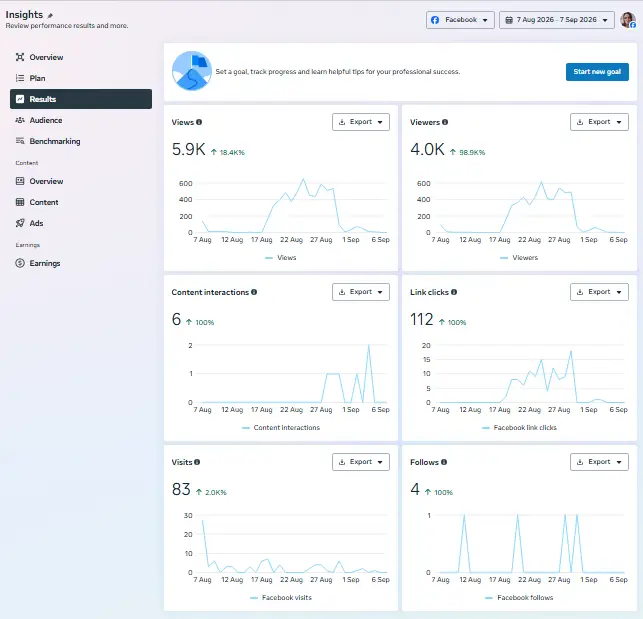
The numbers, platform by platform
Facebook (7 August to 7 September 2026)
- Views: 5.9K
- Viewers: 4.0K
- Content interactions: 6
- Link clicks: 112
- Profile visits: 83
- Follows: 4
Meta changed what "Views" and "Viewers" mean in 2026. Views replaced impressions and now count every time a piece of content appears on screen, including repeat views by the same person. Viewers replaced reach and counts unique people who actually saw it, using a tighter definition than the old reach metric did.[2] Meta rolled this out directly inside Business Suite without a dedicated help page confirming the exact wording, so I am relying on marketing-industry reporting on the change rather than Meta's own documentation here. So the 5.9K figure is total exposure, including repeats. The 4.0K figure is the closer estimate of unique people.
One caution worth naming: Meta shows these as percentage increases (for example, Views up 18.4%). When the starting point is close to zero, as it was for me on day one, percentage growth looks dramatic but tells you almost nothing. I am reporting the actual numbers, not the percentages, for that reason.
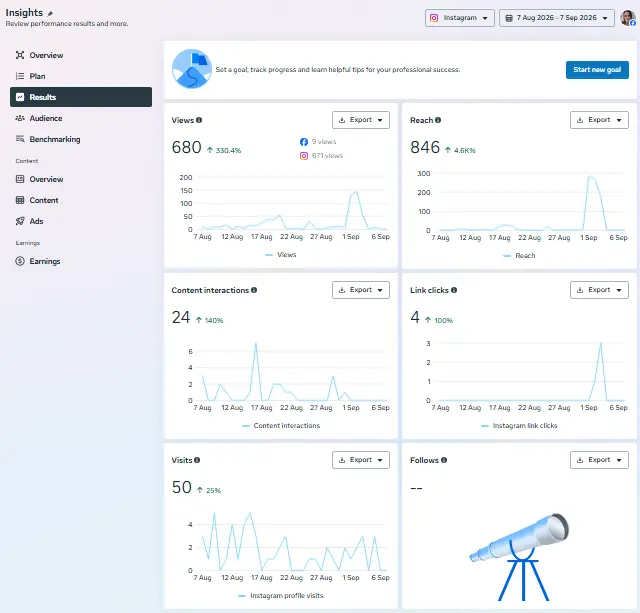
Instagram (7 August to 7 September 2026)
- Views: 680
- Reach: 846
- Content interactions: 24
- Link clicks: 4
- Profile visits: 50
Instagram had more content interactions than Facebook despite far lower visibility, and far fewer link clicks. Small sample, but worth watching: people engaged with the content itself more than they clicked through.
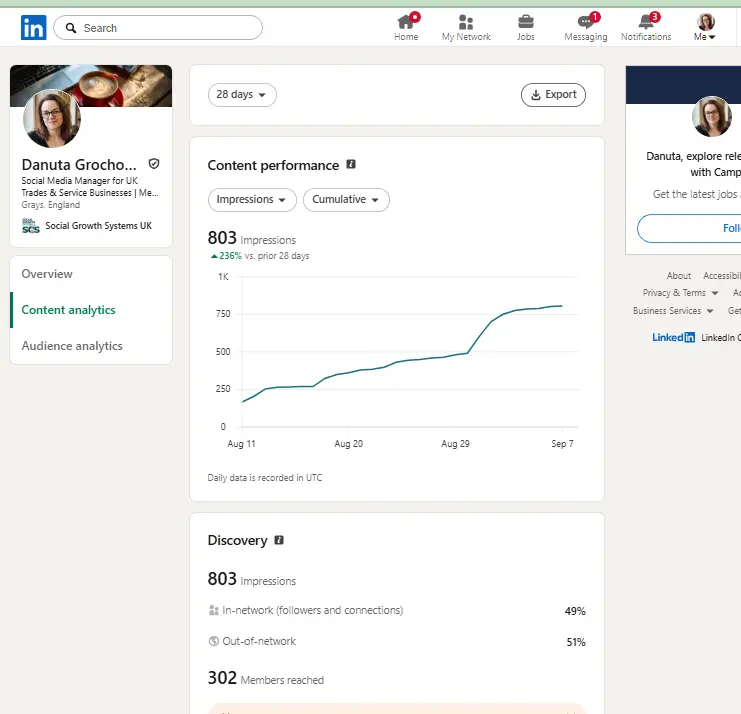
LinkedIn, personal profile (11 August to 7 September 2026, 28-day window)
Note the date range here starts four days later than the other channels because that is the window LinkedIn's own export uses.
- Impressions: 803
- Members reached: 302
- Total followers: 198
- Post impressions, most recent 7 days: 202
- Profile viewers, past 90 days: 40
- Search appearances, 25 to 31 August: 16
This is my personal profile, which I use for authority and network building rather than as a sales channel, in line with how LinkedIn actually performs for a trades-focused business: almost no measurable search volume for trades keywords, but useful for building relationships with decision-makers.[3]
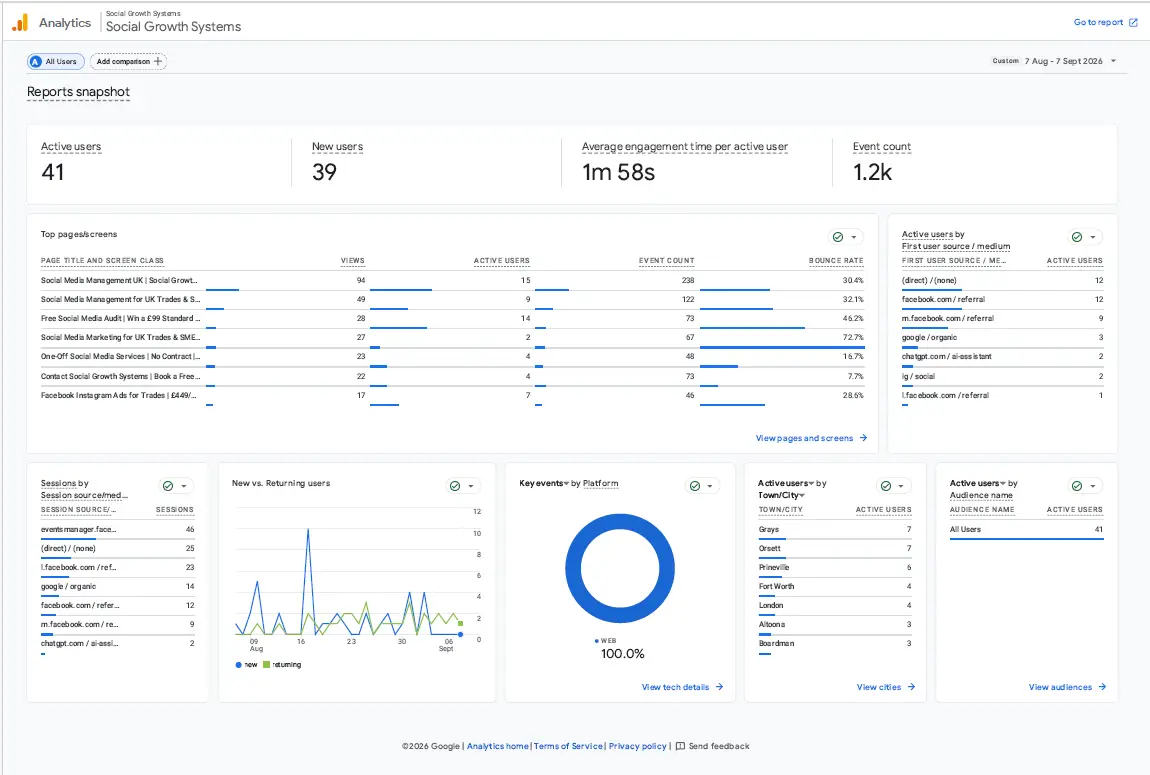
The website (Google Search Console and GA4, 7 August to 7 September 2026, unless stated)
- GA4 active users: 41
- GA4 new users: 39
- Average engagement time per active user: 1 minute 58 seconds
- GA4 event count: 1.2K
GA4's "active users" counts anyone who had an engaged session or is in their first session. "New users" counts first-time visitors, identified by the absence of a prior tracking cookie. The two overlap, which is why they do not simply add up to a single clean total.[4]
Search Console, for the 28-day window ending 5 September 2026:
- UK clicks: 18
- UK impressions: 371
- UK click-through rate: 4.85%
- Total site clicks across all countries: 20 (18 UK, 1 US, 1 Spain), all landing on the homepage
Search Console hides some individual search queries below a certain volume, so I cannot say precisely which search terms produced those 20 clicks, only that they happened. Queries already showing impressions, with no clicks yet, include "builders social media management," "social media for builders" and "how much does a social media manager cost."
The Meta Ads test
Across the full test period, total spend was £33.89, generating 4,283 reach, 6,177 impressions and 116 link clicks, an average of about 29p per link click. This was a genuine, small, real-money test, not a projection. If you want to see how a small test like this actually plays out, I wrote it up in more detail: how a small Meta Ads test performed.
What this data does and does not show
This shows visibility and interest building from a standing start. It does not show leads or sales figures, which is a separate, harder number to move, and it is early days for that. I am not including it here because this piece is about what got seen and clicked, not about business results, and I do not want to blur the two the way a lot of marketing case studies do.
What this means if you are weighing DIY versus paying someone
If you run a trades business and are wondering whether it is worth doing this yourself: the mechanics are not complicated. Posting content, checking Insights, reading Search Console, none of it requires special software. What takes time is knowing which numbers matter, spotting when a platform's definitions have changed under you, and not mistaking a big percentage jump from a near-zero base for real growth. If that sounds familiar, you might also want to read what a social media manager actually costs in the UK, or why I started Social Growth Systems in the first place.
If you would rather have someone look at your own numbers and tell you plainly what is working, what is not, and what to fix first, that is exactly what the Trades Visibility & Enquiry Sprint does. These are my own numbers for my own channels. Yours will depend on your starting point, your industry and what is already in place, and I cannot promise you the same figures.
FAQ
How long does social media marketing take to work?
Most sources describe it as a medium-term channel. Expect the first month or two to be about building the foundation, with more meaningful results typically taking two to three months or longer.
What is the difference between Views and Reach now?
Meta changed its reporting in 2026. Views count every time content appears on screen, including repeat views. Reach was replaced by Viewers, which counts unique people who actually saw it.
Is it normal to have small numbers in the first month?
Yes. Starting from zero followers and zero search history, any growth shows as a large percentage increase, which is not the same as a large absolute number. Read the raw figures, not just the percentage.
Should I start with paid ads?
Not necessarily straight away. Getting the basics right first, meaning a clear profile, a working enquiry path and a genuine reason to click, matters more than budget in the early stages.
Fix the basics before you spend more on marketing.
The £149 Trades Visibility & Enquiry Sprint reviews your profiles, your bio, your enquiry path and your call to action, and hands you a written 30-day action plan plus a 20-minute call. No ongoing contract.
See the £149 SprintSources
- BrightEyes Marketing, "How Long Does It Take for Digital Marketing to Work?", brighteyesmarketing.com, 9 Feb 2026.
- Paladin Marketing, "Meta Reporting Has Changed. What You Need to Know", paladinmarketing.co.uk, 25 Jun 2026; and ExtraDigital, "Meta Reporting Changes in 2026", extradigital.co.uk, 19 May 2026. No primary Meta Business Help Centre page confirming this wording was found at time of writing.
- Social Growth Systems internal keyword research and brand positioning documents, 5 Sep 2026 / 25 Aug 2026.
- Google Analytics Help, "[GA4] Understand user metrics", support.google.com.