
Are You Qualifying Builder Enquiries Before You Start Quoting?
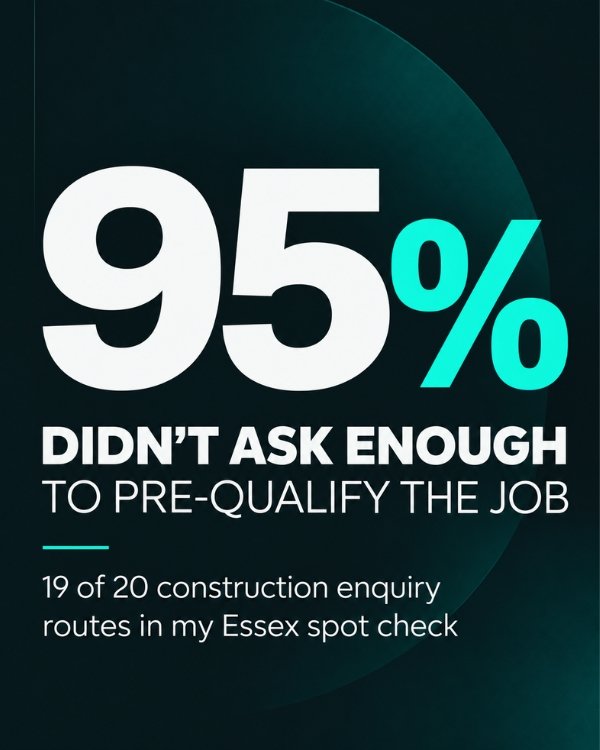
95%. That was the number that made me look twice when I checked 20 publicly accessible enquiry routes belonging to construction businesses in Essex.
I wasn't looking at logos.
I wasn't counting followers.
I wasn't checking whether somebody's Instagram grid matched nicely.
I wanted to know something much closer to the money:
How much does the enquiry process find out before somebody in the business has to pick the lead up and start doing the work?
Only 1 of the 20 enquiry routes I checked collected the minimum combination I was looking for:
- What is the job?
- Where is it?
- When does the customer want it?
- Is there at least one sign that the project is ready enough to discuss, such as a budget or plans?
did not meet that working pre-qualification benchmark before somebody at the business had to pick the enquiry up.
That is 95% of this SGS spot check.
Why qualify builder enquiries before you quote?
The Federation of Master Builders makes a useful point in its current guidance for builders: many builders spend hours visiting properties and preparing quotations for projects that never turn into work.
Some customers are still exploring.Some do not have drawings yet.Some do not have a clear scope.Some have not considered a realistic budget.
The FMB says qualifying enquiries before quoting can help builders spend less time on quotes that go nowhere and focus on projects that are more likely to progress.
That turns the usual marketing question on its head.
Instead of starting with:
“How do I get more enquiries?”
I would also ask:
“What happens to the enquiries I already get?”
How I checked the construction enquiry forms
I used a sub-sample from my wider Essex construction-business research.
I did not choose companies because their forms looked particularly good or bad.I took the first 20 company-owned enquiry routes, in the original sample order, where enough public information was available for me to inspect the route properly.
And one important point:
I did not send a single fake enquiry.
Nobody received a pretend extension request from me at 10pm on a Thursday.
I checked only what a genuine potential customer could see before pressing Submit.
For this spot check, I counted an enquiry route as doing basic pre-qualification only if it collected:
- the project or type of work;
- the project location;
- the intended timing or start date;
- at least one readiness signal, such as budget, drawings, plans or similar project information.
This is an SGS working benchmark, not an official FMB rule.
But it is based on the same type of information the FMB recommends builders consider when qualifying an enquiry.The FMB's own public customer matching form also asks for project postcode, job details, potential start date, potential budget and plans or photos before an enquiry is passed to matched builders.
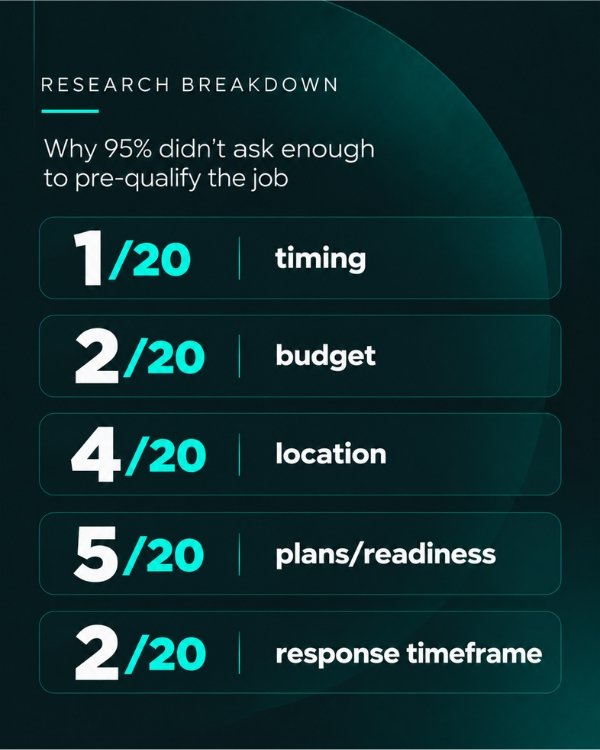
Only 1 in 20 asked when the customer wanted the work to start
did not ask for a start date or timescale in the public enquiry route I checked.
For some jobs, timing immediately changes whether an enquiry is worth pursuing.
If your next suitable slot is November and the customer needs the extension finished by August, that is useful information to know before anybody starts arranging a site visit.
Only 2 in 20 asked about budget
That means 90% did not ask about budget before the enquiry was submitted.
I understand why businesses can be reluctant to ask.
Customers can enter unrealistic numbers.Budget conversations can be awkward.And a budget field on its own tells you very little.
But there is a difference between refusing to quote from a dropdown box and simply knowing whether somebody is thinking about a £30,000 project or a £300,000 one.
That information can change what happens next.
Only 4 in 20 clearly captured the project location
That means 80% did not clearly collect the project location in the public route I checked.
For a construction business, location is not a minor detail.
It affects whether you cover the area.Travel.Labour.Logistics.Site visits.And sometimes whether you want the job at all.
Yet on most of the enquiry routes I checked, location still had to be established afterwards.
Only 5 in 20 invited plans, files or another readiness signal
That is 25%.
Plans do not make somebody a qualified customer automatically.
But there is a fairly significant difference between:
“We're thinking about maybe extending the house one day.”
and:
“Planning is approved, drawings are complete and we want to start in October.”
Both can become good customers.
They are not at the same stage today.
One form showed how different the first conversation can be
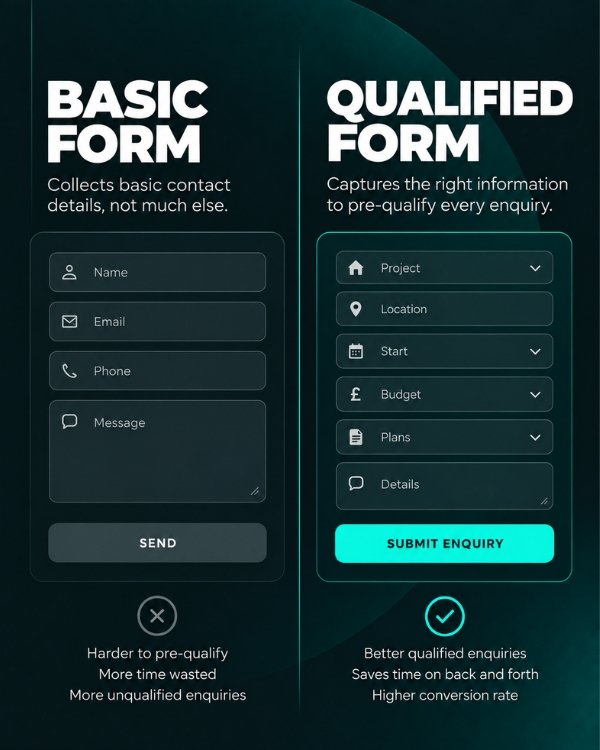
One of the forms in the research asked for property address, job type, budget range, preferred timescale, project details, and photos or measurements.
That does not mean the company automatically wins every job.
It does something much simpler.
It gives the person receiving the enquiry more information before they have to start asking questions.
Another strong example collected the postcode, type of project, planning or design status, project description and an attachment.
It also told the customer that the business would be in touch within 48 hours.
Neither approach requires a complicated CRM, an AI sales bot or a form long enough to apply for a mortgage.
It just makes the next conversation more useful.
Only 2 in 20 gave a specific response timeframe
gave the customer a specific expectation for when the business would respond.
I did not count:
“We'll get back to you as soon as possible.”
That is polite.
It is not a timeframe.
I counted clear expectations such as within 48 hours or usually within one working day.
The customer knows when to expect something.
The business has a standard to work towards.
No interpretive dance required.
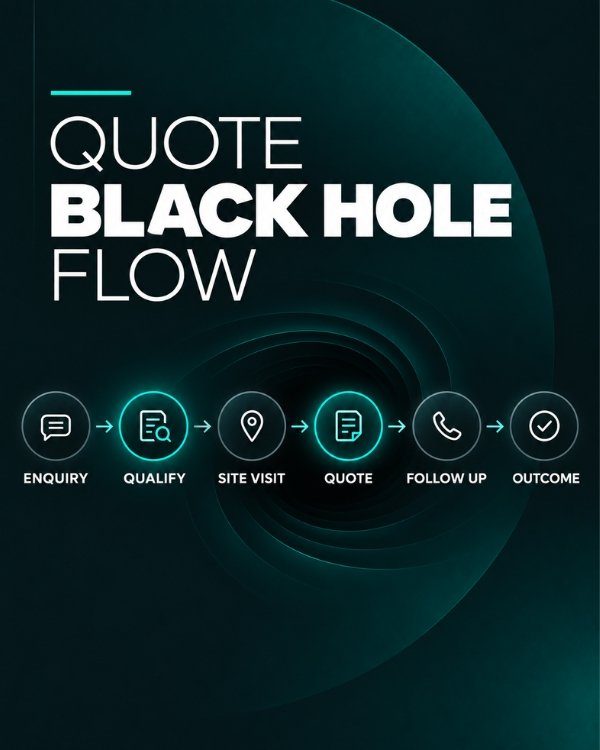
Where the quote black hole starts
Think about the basic journey.
A potential customer finds the company.
They like the work.
They trust what they see.
They decide to enquire.
Then they send:
Name. Email. Phone. Message.
And perhaps:
Hi, looking for an extension. Can you give me a quote?
Now somebody in the business still has to establish location, scope, drawings, timing, project stage and whether the job is even relevant.
Then perhaps arrange a call.
Then perhaps arrange a site visit.
Then perhaps price the work.
Then send the quote.
Then, ideally, remember to follow it up.
There is nothing wrong with having a conversation.
Construction is not an Amazon checkout.
You cannot qualify a substantial building project with four dropdowns and a cheerful green tick.
But the first enquiry can do more of the basic sorting before it reaches somebody's desk.
Qualification is only the start of the enquiry process
The FMB describes a simple sales process as:
Enquiry → Qualification → Site visit → Quotation → Follow-up
Its guidance also warns that projects can be lost if the process is not managed consistently, including through delayed responses or quotation follow-up.
Even a simple spreadsheet can help track stages such as enquiry received, site visit completed, quote sent and follow-up scheduled.
This is the bit I think gets missed when people talk about construction marketing.
Marketing does not finish when somebody presses Submit.
That is where the commercial process starts.
More construction leads can also mean more admin
Imagine spending money on Facebook Ads, Google Ads, social media, SEO or directories to create more attention.
Then enquiries arrive.
But there is no consistent way to qualify them, prioritise them, record the source, schedule the next action, track the quote or remember the follow-up.
More enquiries may still be useful.
They can also mean more calls, more chasing, more site visits and more quotes.
That is why I will not automatically tell a construction company:
“You need more leads.”
Sometimes you do.
Sometimes the first job is making sure the enquiries you already have are handled properly.
Check your own builder enquiry form
Go to your website as if you were a potential customer.
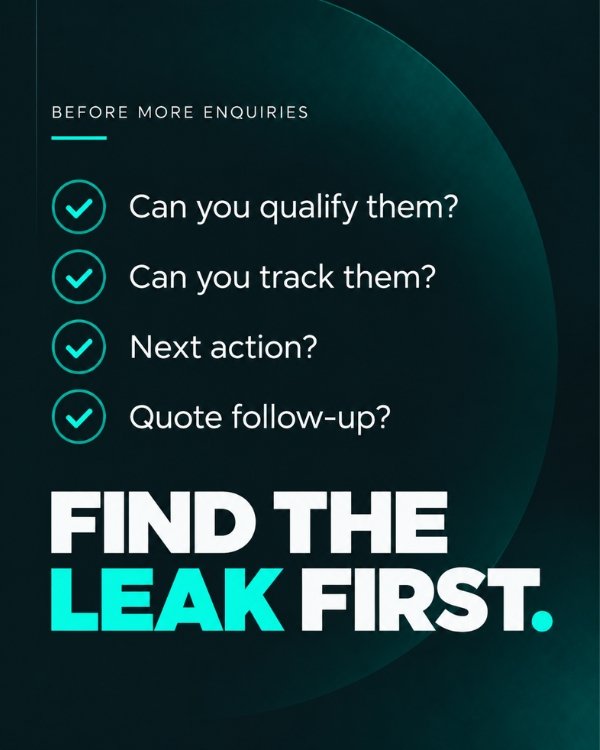
Can they tell you what they want done?
Can they give you the project location?
Can they tell you when they want to start?
Can they show whether drawings or plans exist?
Can they give enough information about budget or scale to help you decide what should happen next?
Then look beyond Submit.
Does the customer know the enquiry arrived?
Do they know when to expect a response?
Internally, does every enquiry have an owner and a next action?
Does every quote have a follow-up date?
If not, I would look there before automatically paying for more traffic.
You may not need more enquiries
You might.
But first I would want to know:
What happens to the ones you already have?
If marketing creates interest and the next stage relies on memory, manual chasing and a contact form that tells you almost nothing about the job, there is something worth checking before increasing the volume.
More traffic into a leak is still a leak.
Just busier.
Check your enquiry path first
Use my free 5-Minute Enquiry Path Check for Builders to look at what happens from the moment somebody finds your business to the point where they decide whether to make contact.
Run the free 5-Minute Enquiry Path CheckResearch note
I reviewed 20 publicly inspectable company-owned enquiry routes from an Essex construction-business sample on 24 September 2026.
The businesses were not selected based on whether their enquiry forms were strong or weak. No fake enquiries were submitted.
For this SGS spot check, a route met the working pre-qualification benchmark only when it collected project or scope, project location, intended timing and at least one readiness signal such as budget or plans.
This benchmark is an SGS research definition, not an FMB standard.
The study looks only at what was publicly visible before enquiry submission.It does not show what happens during subsequent calls, internal qualification, CRM workflows or follow-up.It does not measure conversion rate, sales, revenue or lost enquiries.
19 of the 20 routes did not meet that specific benchmark. That is the basis of the 95% figure used in this article.