
Short answer: yes, Facebook and Instagram ads can work well for a building firm, but only once your pages look professional and you know what a good enquiry is actually worth to you.
Run properly, they put your work in front of local homeowners who are planning a project right now. Run badly, they buy you likes from people three counties away who were never going to book anything. Here is how to tell the difference before you spend.

When ads earn their keep, and when they do not
Paid ads amplify. They do not fix.
Three things need to be true before you put money behind anything:
- You have real photos of finished work. Ads send people to look at you. If your Instagram has eleven posts and the last one is from 2023, you have paid to show a stranger a reason not to ring you.
- Your pages look like an active business. Clear service description, the area you cover, a way to get in touch, some evidence of recent work. This takes an afternoon and costs nothing.
- You can answer an enquiry quickly. This is the one builders underestimate. A homeowner filling in a form on a Tuesday evening is usually filling in three. The one who replies first has an enormous advantage.
If all three are true, ads can put your name in front of people considering an extension, a renovation or a loft conversion in your area. If any one of them is false, fix that first. It is cheaper.
What will it cost? Do this maths first
I am not going to quote you a cost per enquiry, because I do not know your area, your competition or what you are advertising, and anyone who gives you a figure before seeing those things is guessing.
What I can give you is the sum to do before you spend anything. It takes ten minutes and it is the difference between advertising and gambling.
What is one job actually worth to you?
Not the invoice. The profit. A £30,000 extension that leaves you £4,000 after materials, labour and your own time is a £4,000 job for this purpose.
How many enquiries do you need to win one?
You already roughly know this. If you quote five jobs to win one, that is your number.
Divide.
£4,000 divided by five enquiries means one enquiry is worth £800 to you. That is your ceiling. Anything below it and the ads are paying for themselves.
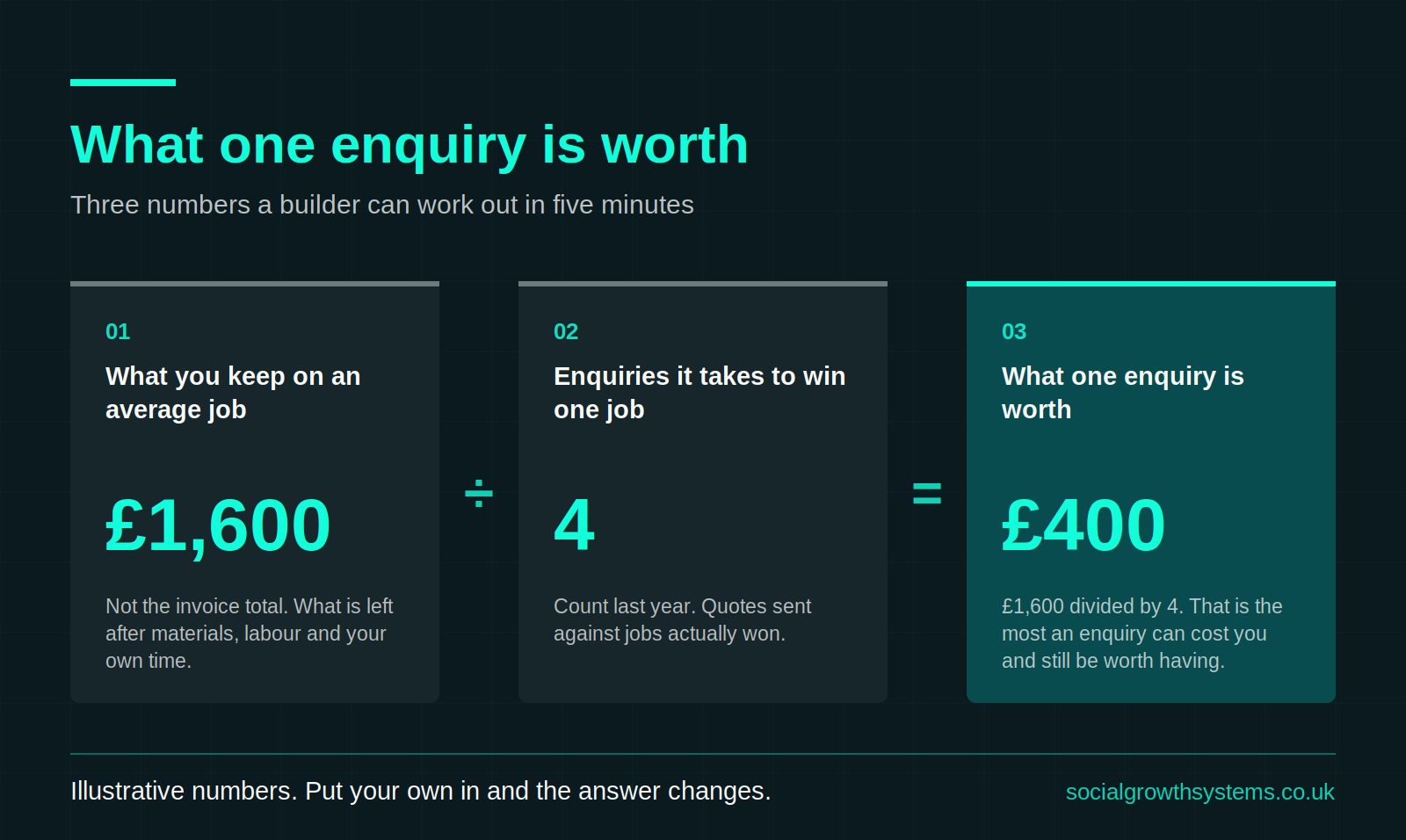
Those numbers are invented to show you the method. Yours will be different, and nobody, me included, can tell you what an enquiry will actually cost you until the ads have run. That is what a test budget is for.
What that sum does is stop you panicking. Builders regularly turn ads off after a week because they spent £180 and got two enquiries, without working out that two enquiries were worth £1,600 to them.
On budget, my own recommendation is around £15 to £20 a day, which is roughly £450 to £600 a month, and to give it three months. Less than that and you are usually funding a learning period you never get the benefit of. That is my view based on how the platform behaves, not a promise about what it will return.
One number people mix up
Your ad spend goes directly to Meta, and it is separate from whatever you pay anyone to manage it. Be clear which number you are looking at when someone quotes you.
Why boosting a post is not advertising
The most common way a builder loses money is the blue Boost button.
Boosting takes a post that already exists and shows it to more people, usually with almost no targeting and no goal beyond engagement. You get cheap likes, a little dopamine, and no work. It feels like something happened. Nothing did.
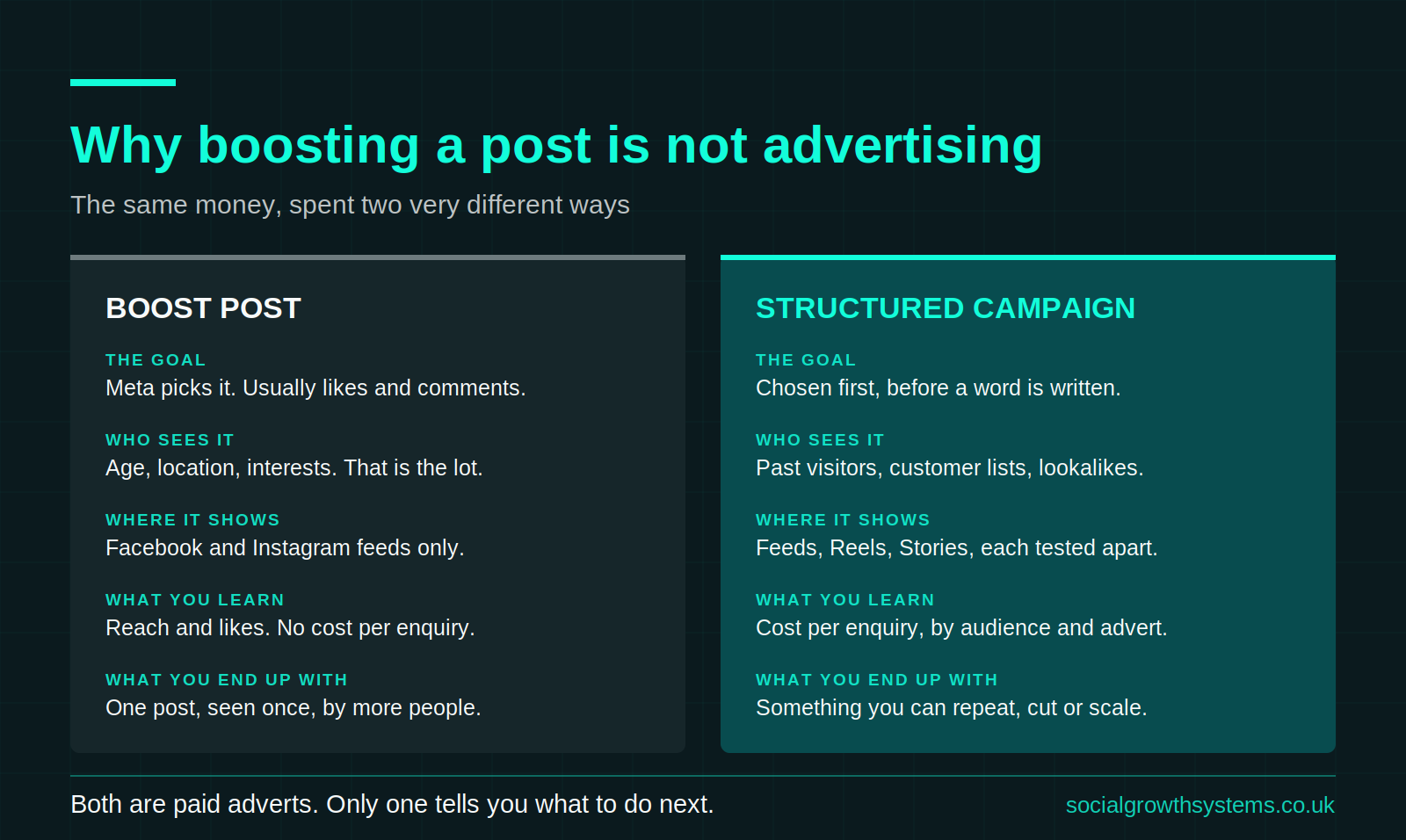
A proper campaign is a different thing. It has an objective chosen deliberately, an audience defined by area and circumstance, ad copy written for one specific job rather than for everything you do, and a destination that makes enquiring easy. It gets tested, and the version that does not work gets turned off.
The difference is not budget. It is whether there was a plan.
What happens after the click
Almost nobody writes about this and it is where most builders' money actually leaks.
Decide before you launch where an enquiry lands. A form attached to the ad, a message, a WhatsApp, or a phone call. Each behaves differently. Forms get you more enquiries of lower average quality, because they take four seconds. A phone call gets you fewer and better.
Then decide who answers, and how fast. If you are up a ladder until six, that is fine, but somebody or something needs to acknowledge the enquiry before then. A one-line reply saying you will call tonight will hold a homeowner who would otherwise have moved on.
The best-targeted campaign in Britain dies quietly in an unread inbox.
What you are allowed to say in a builder's ad
This is the part most builders have never heard about, and it applies to you whether you run ads or just post on your own page.
The Advertising Standards Authority confirms that the UK ad rules apply to every business advertising in UK media, from a sole trader upwards, and that they cover claims and offers on your own social media channels and website, not only paid advertising space.
In practice, for a building firm:
- Claims need evidence. The ASA's own summary puts it plainly: "If you can't prove it, you probably shouldn't say it." "Cheapest in the area", "the region's leading builder" and "25 years experience" are all objective claims you would need to back up.
- Free has to mean free. You cannot describe something as free if the customer has to pay you anything for it beyond an uninflated postage cost. Free quotes are fine if the quote genuinely costs nothing.
- Offers need an end date. If you run a promotion, the closing date and the significant conditions go in up front, not in a reply to a comment.
- Prices must be complete. An advertised price has to relate to what is actually shown and include non-optional costs and charges.
- Reviews need permission. If you use a testimonial, you need evidence it is genuine, the person's contact details, and their permission to use it in marketing. Screenshotting a customer's Facebook comment into an ad without asking is exactly the habit this rule is about.
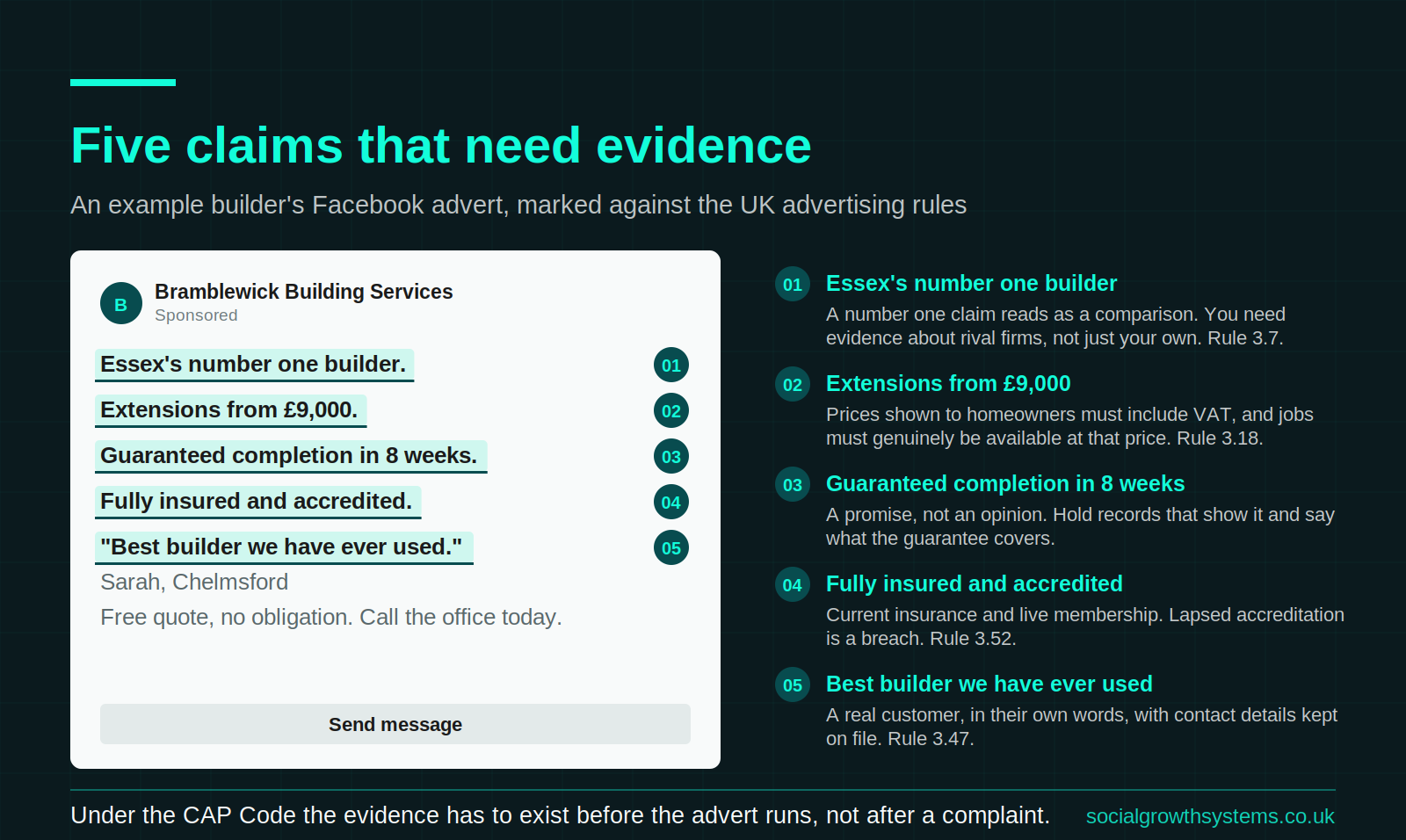
The bit that tends to focus minds: the ASA acts on complaints from members of the public and from competitor businesses, as well as its own proactive work. A rival firm can report your ad.
Worth saying plainly
This is a plain-English summary, not legal advice, and the ASA's site has the detail if you want it.
How to tell whether it worked
Judge ads on enquiries and booked work. Nothing else.
Likes, reach and impressions tell you the ad was seen. They do not tell you it worked, and every builder who has been sold a "great engagement" report knows the feeling.
You do not need software. A notebook will do. For each month, write down what you spent, how many enquiries came in, how many turned into quotes, and how many turned into jobs. Three months of that tells you more than any dashboard.
Then compare it against the number you worked out earlier. That is the whole test.
Ads or organic first?
Organic first, always.
Build an active, credible presence with real work on it, then put money behind it. If you have not done that yet, get your organic pages right first and come back to ads afterwards. Ads make a good page work harder. They cannot make a bare one work at all.
The honest bit
I cannot promise you a set number of leads from any budget, and anyone who does is guessing or hoping you will not check.
What is fair to say is this: ads reward builders who already look credible, respond quickly and know what a job is worth to them. If those three are not in place, paid advertising will find the weakness faster and more expensively than anything else you could do.
Free checklist: tick this before you spend a penny on Facebook or Instagram ads.
If you want this set up properly
If you would rather not learn objectives, audiences, testing and budgets yourself, that is the work I do.
If you want it managed
Facebook and Instagram ads, run for you
My Facebook and Instagram ads for trades service covers strategy, creative, copywriting, technical setup, controlled testing and daily monitoring, with a monthly report in plain numbers: spend in, enquiries out, cost per result.
The page sets out the fee, the recommended minimum budget and the minimum term, so you can see the whole picture before you speak to anyone. There is a full PDF breakdown on there too, no email required.
Ask about Meta Ads readinessIf it looks like a fit, get in touch and I will explain whether your offer and enquiry route look ready for paid traffic. If I think they would not, I will tell you that instead.
If you only want the campaign built
Some builders are happy to press go and watch the budget themselves, they just do not want to build the thing from scratch. For that, I offer a one-off Meta Ads Campaign Build (Facebook & Instagram) at £349 with a matching branded post.
You get a written strategy, audience research, several versions of the ad copy, the campaign built in Ads Manager, and a testing plan with the numbers to watch. Build only, no ongoing management, and you can buy it directly without a call.
Frequently asked questions
Are Facebook ads worth it for builders?
They can be, once your pages look credible and you can answer an enquiry quickly. Work out what one job is worth to you in profit and how many enquiries you need to win one. That gives you a ceiling to judge the ads against.
How much do Facebook ads cost for a builder?
There is no fixed figure, and it depends on your area, your competition and what you are advertising. As a starting point I would suggest around £15 to £20 a day for at least three months. Your ad spend goes to Meta and is separate from any management fee.
Why did boosting a post not work?
Boosting shows an existing post to more people with little targeting and no real goal. It buys engagement, not enquiries. A structured campaign has an objective, a defined area, copy written for one job and a clear route to enquire.
Should I do ads or organic posting first?
Organic first. Ads amplify what is already there. If your pages are thin, ads will just show more people a reason not to call.
Are there rules about what I can say in a Facebook ad?
Yes. UK advertising rules apply to sole traders and cover your own social media as well as paid ads. Claims need evidence, "free" must genuinely be free, offers need an end date, and testimonials need the customer's permission. Members of the public and competing firms can both complain to the ASA.
Can you guarantee how many leads I will get?
No, and nobody honestly can. Performance depends on your offer, your area and your budget.
Source for the advertising rules section: Advertising Standards Authority and Committee of Advertising Practice, Advice for businesses. Accessed 20 August 2026. This is the ASA's own summary rather than the full CAP Code, and it is guidance rather than legal advice. The page carries no publication or last-updated date, so currency cannot be confirmed from the page itself.